ShingleMaster, CertainTeed’s ShingleMaster credential
400+ Verified Reviews Across Google & BBB
Sister Firm: IHC Public Adjusters (IL Licensed)
State Roofing License #104.015093 on File
Richmond Burns Down and Builds Back Up — That’s the Story of This Town

Christmas Eve, 1902. Fire tore through Richmond’s commercial district and leveled 20 buildings in a single night. The whole downtown, gone. And what did this village of a few hundred people do? They rebuilt every last structure. Brick by brick, board by board, through an Illinois winter. That resilience is baked into Richmond’s DNA, from William McConnell driving the first stake into the ground along the North Branch of Nippersink Creek in 1837 to the families raising kids here right now off Route 12 and IL-173.
I respect that. I also respect that Richmond is a village of roughly 2,100 people sitting at the northernmost edge of McHenry County, pressed right against the Wisconsin border, catching every northwest storm system before any other city in our territory. Open farmland on three sides. Nippersink Creek cutting through the middle. No dense suburban canopy to break the wind. When a storm cell drops out of Kenosha County heading southeast, Richmond absorbs the first punch.
Our office sits at 4410 IL-176 in Crystal Lake, about 25 minutes south on Route 31 to Route 12. I’ve driven that stretch to Richmond more times than I can count, past Spring Grove, past the turnoff for Glacial Park, into a village where Old No. 90 still stands from 1844 and the Sarah Gibbs House is the only Second Empire residence left in the area. We hold Illinois Roofing License #104.015093, carry $1 million in general liability, maintain an A+ BBB rating, and have 400+ Google reviews across platforms. Women-led, Wilborn family, same address for 21 years. Richmond is small. So is our company. That’s a feature, not a limitation.
The Storms That Punish Richmond First
Richmond sits at 784 feet of elevation on flat agricultural terrain with minimal windbreak. Storms rolling southeast from Wisconsin hit this village before they reach McHenry, Woodstock, or Crystal Lake. The Nippersink Creek corridor amplifies moisture content in the air column. And 2024 broke the Illinois state record with 142 confirmed tornadoes. Here’s what Richmond has absorbed in just the last three years.
| Date | What Happened | Richmond Impact |
|---|---|---|
| August 16–19, 2025 | Severe thunderstorm complex, 60-70 mph winds, hail, tornado warnings | Richmond sat directly in the impact corridor. Power outages across northern McHenry County. Downed limbs along Route 12 and Broadway. Agricultural properties on the village perimeter took unobstructed wind damage with no neighboring structures to reduce exposure. Glacier Lake Estates and rural lots south of IL-173 reported shingle debris in yards. |
| July 15, 2024 | Derecho, 32 tornadoes across Chicagoland, 70+ mph gusts, flash flooding | Richmond in the northwestern impact zone. Nippersink Creek flooded banks, pushing moisture into crawl spaces and basements along the creek corridor southeast of Broadway. Wind channeling through the open terrain north of the village peeled shingle edges on homes facing northwest. Mature trees surrounding Conservation District land dropped branches onto rooflines in Glacier Lake Estates. |
| May 7, 2024 | EF-0 tornado confirmed near Harvard, 2.1″ hail | Harvard is 10 miles north. The closest confirmed tornado to Richmond in recent memory. Hail tracked across the Route 173 corridor into the village. Granule displacement on south-facing and west-facing slopes throughout the historic downtown core along Main Street. Gutter denting on homes along George Street and Mill Street. |
| April 4, 2023 | 1.5″ ping-pong ball hail, 70+ mph wind gusts | Bruised shingle mats across McHenry County. Richmond’s post-war ranch homes south and east of the downtown core, many with original 1960s-era roof geometry and minimal attic ventilation, sustained granule loss that wouldn’t become visible until spring 2024 downspout inspections. |
| April 3, 2026 | Severe storms, 50-60 mph gusts, downed trees | Road closures near Wonder Lake, directly adjacent to Richmond. Power lines down along Route 12 north of the village. Rural properties with long roof runs and exposed ridgelines absorbed sustained wind loading that standard suburban homes never experience. |
Five documented storm events in three years. Illinois posted a record 142 tornadoes in 2024 alone. Richmond’s geographic position — northernmost in the county, closest to Wisconsin, surrounded by open farmland — means every single storm system that builds over the plains hits this village at full strength before terrain, trees, or buildings have a chance to diffuse it. If your Richmond roof predates 2020 and has weathered all five of these events, it’s not performing the way the manufacturer rated it. That’s not speculation. That’s material science.
Roofing Materials Engineered for the Northern Border
Full tear-offs, targeted repairs, storm damage restoration, and premium system upgrades. Hand-picked specialist crews on every Richmond project, hand-picked specialist crews — vetted and long-tenured.
CertainTeed Landmark Architectural Shingles →
The workhorse for most Richmond homes. Whether it’s an 1890s Victorian in the historic downtown core along Main Street or a 1960s ranch south of Broadway, we strip to bare decking, inspect every sheet of plywood for moisture damage — on Nippersink Creek properties, we find soft spots more often than not — install ice and water shield to code, and lay shingles to CertainTeed’s exact manufacturer spec. Our ShingleMaster certification activates SureStart PLUS, 50-year coverage on materials and labor. The majority of roofers working Richmond cannot match that warranty. We can, because we earned it.
✓ CertainTeed ShingleMaster
F-Wave Synthetic Shingles
Class 4 impact rating. The highest you can get. Replicates the look of natural slate but handles the kind of 70-mph wind and 2-inch hail that rolls across Richmond’s open terrain without cracking or splitting. For homeowners in Glacier Lake Estates who invested $500,000+ in a custom build surrounded by Conservation District land, F-Wave eliminates the cycle of hail claim after hail claim. Multiple insurance carriers drop your premium when a Class 4 product goes on the roof. I’ve had Richmond homeowners tell me the insurance savings alone justified the upgrade within four years.
Brava Composite Roofing
Composite that mimics cedar shake or Spanish tile, 50-year lifespan, zero maintenance cycles. Richmond’s historic downtown has homes where the owner wants a roof that honors the character of an 1880s structure without the 7-year replacement burden that real cedar demands. No moss buildup. No splitting. No absorbing Nippersink Creek humidity and warping by year three. Brava installs lightweight enough that the vast majority of Richmond’s older structures need zero structural reinforcement.
InnoMAXX Program
Our proprietary premium roof system: CertainTeed Landmark PRO shingles, ice and water shield across the entire deck — not just the eave line code requires — synthetic underlayment, premium ridge vent, and a transferable 50-year CertainTeed SureStart PLUS warranty bundled into one price. I built this package specifically for environments like Richmond’s. The Nippersink Creek moisture corridor attacks decking from below while precipitation hammers from above, and the open farmland surrounding the village means wind loads that sheltered suburban neighborhoods never see. Every home within a quarter mile of Nippersink Creek and every rural property with a roof span exceeding 60 feet should treat InnoMAXX as the starting point.
Storm Damage Repair →
Hail strikes, wind lift-off, branch impact, microburst damage — we photograph and document every square foot, scope the repair in Xactimate at line-item detail, and execute the work. Our sister company, IHC Public Adjusters, a separately licensed Illinois public adjusting firm, handles your claim from initial filing through supplement negotiation (financial relationship disclosed per 215 ILCS 5/1575). The homeowner decides whether to engage them. After the May 2024 tornado tracked just 10 miles north of Richmond near Harvard, that decision matters for anyone whose carrier is dragging their feet on a legitimate payout.
Targeted Repair
Not every roof in Richmond needs a complete tear-off. A blown section on a 10-year-old Glacier Lake Estates home. A failed pipe boot on a 1960s ranch off Kenosha Street. A chimney flashing leak on one of the historic downtown structures along Broadway. We fix the problem and buy the roof another 5 to 10 years of functional life. I’ll also tell you straight if a repair is just delaying an inevitable replacement. That conversation happens at your kitchen table, not after you’ve already written a check.
What “Neversink” Means for Your Roof
The Pottawatomi called it “Neversink”, place of small waters. They named Nippersink Creek that for a reason. This waterway is the largest tributary feeding into the Fox River, and it winds through Richmond’s entire footprint. The creek doesn’t dry up. It doesn’t recede. It sits there year-round, pumping moisture into the air column above every home within a half mile of its banks. Southeast of Broadway and Main Street, the homes closest to the creek live inside a humidity envelope that most roofing materials were never tested against at the factory.
Then add Richmond’s position on the map. This is the northernmost community in our service territory. Slightly colder winters than Crystal Lake or Woodstock. Slightly heavier snowfall accumulation. A 90-degree-plus annual temperature swing from sub-zero January nights to low-90s July afternoons. Every material on your roof expands and contracts through that range dozens of times per season: shingles, flashing, sealant compound, pipe boots. Multiply those thermal cycles across 20 or 30 years and the math stops working in your favor long before the warranty expiration date arrives.
Wind exposure is the third factor, and it’s the one most contractors ignore. Richmond isn’t tucked into a suburban grid where houses shelter each other. The rural properties along the village perimeter sit on multi-acre lots with no windbreak between them and the Wisconsin state line. Long roof runs on farmhouses and pole barns catch sustained wind loading that a 30-by-40-foot suburban roof never experiences. Even the homes in the historic downtown core sit at 784 feet of elevation on flat terrain, storms arrive unimpeded. Adjacent Glacial Park draws 65,000 visitors annually for a reason: the landscape is wide open. Beautiful for hiking. Brutal on roofing.
Ice dams close the loop. Creek moisture from below. Heavy shade from mature trees along Broadway and the Conservation District canopy bordering Glacier Lake Estates. Sub-freezing temperatures that persist longer here than in towns 15 miles south. Richmond is prime ice dam territory. Our InnoMAXX system, full-deck ice and water shield, not just eave coverage, exists because villages like this one punish code-minimum installations.
Our Richmond Roofing Process
A Person Picks Up — Not a Recording
Call or text (815) 356-9020 and you reach someone who schedules your inspection that week. Richmond is roughly 25 minutes from our Crystal Lake office via Route 31 to Route 12, we get there fast. The inspection covers every roof plane, attic ventilation and decking moisture levels, and every flashing detail around chimneys, vents, and skylights. On Nippersink Creek corridor homes, particularly the properties southeast of Broadway and Main, I bring a pin moisture meter for fascia boards because the creek humidity travels behind paint that still looks solid from the ground.
A Real Proposal — Every Dollar Visible
You receive a written document with each component priced on its own line: shingle count, underlayment type, ice and water shield square footage, flashing material, ridge vent spec, drip edge, haul-away, and labor. Richmond’s median home value sits near $225,800, but Glacier Lake Estates lots list north of $775,000. The range in this village is dramatic. Regardless of where your home falls, you see exactly where every dollar goes. GreenSky financing is available for homeowners who want to spread cost over time. The proposal stands until you’re ready. No expiration gimmicks.
Permits Through Village Hall on Hunter Drive
Richmond’s Village Hall operates at 5600 Hunter Drive. Building permits are required for roof replacements under the McHenry County building codes the village has adopted. We handle every piece of that process: application, fee payment, inspection scheduling, and Lead Paint Certification for pre-1978 homes in the historic downtown core. You never set foot in Village Hall or wait on hold with the building department. Their number is (815) 678-4040 if you want to verify anything independently.
Tear-Off, Discovery, Build-Up, Walk-Through
Our specialist crew strips every layer to bare decking. In a village built along Nippersink Creek with housing stock dating to the 1840s, discovery is part of the job — board sheathing that’s been covered and re-covered for over a century, plywood with creek-corridor moisture trapped underneath, OSB that crumbles when you lift it. We replace every compromised sheet before underlayment goes down. Ice and water shield, synthetic underlayment, manufacturer-spec flashing, and your selected material get installed in proper sequence. Magnetic nail sweep covers the full property. You and I walk the finished roof together, and I hand you the warranty packet plus the CompanyCam photo record of every stage from teardown to final inspection.
Richmond Catches Every Storm Before the Rest of the County
The northernmost village in our service area sits on flat farmland with Nippersink Creek running through the center. Five major storm events in three years. Housing stock ranging from 1840s landmarks to 2000s luxury builds. Whether your home is a historic downtown structure on its fourth roof or a Glacier Lake Estates custom build that just survived its first serious hail, the inspection is free and the assessment is blunt. GreenSky financing available.
Wilborn family since 2005 • CertainTeed ShingleMaster • IL License #104.015093 • A+ BBB • Best of Fox since 2011
Why Richmond Homeowners Pick IHC for Roofing
A Small Village Deserves a Contractor Who Stays Small on Purpose
Richmond has about 2,100 residents. We have fewer than 20 employees. That’s intentional. I’m not trying to become a 200-person operation churning through McHenry County subdivisions by volume. We take on enough work to do it right and turn away the rest. When you call our Crystal Lake office at 4410 IL-176, you get someone who recognizes your voice by the second call. In a village this size, that’s the only way roofing should work.
1902 Taught Richmond to Demand Proof — We Bring It
A town that rebuilt itself from 20 burned buildings on Christmas Eve doesn’t take anybody at their word. Shouldn’t. We carry Illinois Roofing License #104.015093 on file with the state. We hold CertainTeed’s ShingleMaster designation, their highest contractor tier, not a weekend seminar you can buy. We’ve been at the same Crystal Lake address since 2005. Same phone number. Same family. Every credential is verifiable in five minutes. Richmond-Burton Rockets fans know that scoreboard doesn’t lie. Neither does ours.
Every Worker on Your Roof Gets a W-2 From Us
No temp labor. No subcontracted crews who showed up from Indiana last Tuesday. Every person installing your Richmond roof is a vetted IHC installer of Innovative Home Concepts. They trained with us. They answer to us. When a warranty callback comes in three years from now, I know exactly who installed which course and how to reach them. Storm chasers cycle through temp crews that evaporate the moment the truck pulls away. A 50-year warranty backed by a crew that can’t be located six months later is a brochure, not a promise.
ShingleMaster Means a Warranty Most Roofers Physically Cannot Offer
CertainTeed awards ShingleMaster based on demonstrated installation quality over years: verified, audited, renewed. The tangible benefit to you: SureStart PLUS coverage running 50 years across both materials and labor. Purchase the identical Landmark shingles from a non-certified contractor and you receive a weaker warranty covering materials only. On a Nippersink Creek home where humidity stress-tests every component constantly, that labor coverage is the gap between a free fix in year 14 and a $4,500 invoice.
The Roof Is Where Damage Starts — Not Where It Stops
Nippersink Creek humidity corrodes gutters, rots siding from behind, and degrades window seals in half the time inland homes experience. When our crew is on your Richmond roof, they photograph every exterior surface and flag cascading problems before they compound into five-figure repairs. The InnoMAXX package ties the full system together — deck, underlayment, ventilation, flashing — under one scope so nothing gets treated in isolation while the real problem festers two feet away.
A Separately Licensed Adjusting Firm in Your Corner
The carrier sends an adjuster with one directive: minimize the payout. That’s the game. Our sister company, IHC Public Adjusters, holds a separate Illinois public adjusting license and works exclusively for the homeowner, not the insurance company. They write Xactimate scopes at line-item granularity and negotiate supplements until the settlement reflects the actual cost of repair. You choose whether to hire them. Financial relationship disclosed per 215 ILCS 5/1575. After the 2024 derecho and the May tornado near Harvard, plenty of Richmond homeowners are learning what “adjuster disagreement” really means.
Richmond Neighborhoods We Know Roof by Roof
Richmond isn’t one housing market. It’s six different ones compressed into 4.29 square miles. A luxury estate bordering conservation land sits a half mile from an 1844 landmark building. Here’s what we see when we get on each roof.
Historic Downtown / Original Village (1840s–1920s) — Oldest Roofs in IHC Territory
Along Main Street, Broadway, Mill Street, George Street, and Kenosha Street. This housing stock ties with Marengo for the oldest in our entire service area. Victorian, Italianate, vernacular frame structures, some pushing 180 years old. Old No. 90, built around 1844 by Charles Cotting, is the oldest standing building in Richmond. The Lucien Bonaparte Covell House sits blocks away. The Sarah Gibbs House is the sole Second Empire-style residence remaining in the vicinity. The State Bank of Richmond has operated since 1890. These structures are on their third, fourth, even fifth roof. The challenges are stacked: original board sheathing underneath layers of material, plumbing vents rerouted across decades, chimney flashing that’s been caulked over instead of properly replaced, and attic ventilation that was designed for seasonal occupancy and never upgraded when these homes became year-round residences. Lead Paint Certification is mandatory on any structure predating 1978. We carry it and submit it with every permit application automatically.
Post-War Residential (1950s–1970s) — Everything Past Its Expiration
South and east of the downtown core. Ranches, small colonials, capes, modest homes built for the post-war boom. These are 50 to 70 years old now, and every single one has blown past the lifespan of any original or second-generation roofing material. The roof geometry on these ranches is simple, low pitch, minimal valleys, which keeps replacement costs manageable. But the simplicity masks a problem: the low pitch means water moves slowly off the surface, granule loss accelerates in ponding zones, and ice dams form more readily because meltwater has nowhere to go quickly. Attic ventilation is consistently undersized on these homes. A 1960s ranch with a 3-in-12 pitch and no soffit vents is basically a moisture trap wearing shingles. CertainTeed Landmark is the standard recommendation, but InnoMAXX is the smart one.
Nippersink Creek Area (Various Eras) — The Moisture Zone
Southeast of the Broadway and Main intersection, homes that sit along or near Nippersink Creek, the waterway the Pottawatomi named “Neversink.” They named it that because the water level stays constant. These homes live inside a persistent humidity corridor that accelerates every form of roofing deterioration. Granule loss happens faster. Underlayment degrades sooner. Sealant compounds on pipe boots and skylight gaskets fail years ahead of schedule. Spring snowmelt and heavy summer rain push the creek over its banks, flooding low-lying yards and saturating soil that wicks moisture upward into foundations and wall cavities. I’ve pulled decking off Nippersink Creek homes and found black mold colonizing the underside of plywood that looked perfectly solid from the attic. Full-deck ice and water shield is non-negotiable here.
Glacier Lake Estates (2000s) — Premium Market Inside a Small Town
One hundred ten acres. Seventy-three large home sites. Surrounded by hundreds of acres of McHenry County Conservation District land. This is a completely different market than anything else in Richmond, custom-built luxury homes on generous lots, some listing north of $775,000, inside a village where the median home value is $225,800. The contrast is stark. These are the newest roofs in Richmond, but “newest” still means 20-plus years old on the earliest builds, and the Conservation District tree canopy bordering the development dumps organic debris onto rooflines that would otherwise be pristine. Leaf litter holds moisture against shingle surfaces. Branch falls during storms are a recurring issue. F-Wave synthetic or Brava composite is the right conversation for these homeowners, the investment matches the property value, and the Class 4 impact rating eliminates the hail-claim cycle that flat, open terrain makes inevitable.
Spring Grove Estates Border Area (Mixed Eras) — Two Villages, One Storm Path
Northwest of the Nippersink Creek area, where Richmond blurs into neighboring Spring Grove. Mixed housing ages, some mid-century, some 1980s and 1990s builds. The municipal boundary runs through here in a way that confuses permit requirements, and homeowners sometimes aren’t sure which village jurisdiction applies to their address. We sort that out before any paperwork gets filed. Roofing conditions mirror the creek corridor, proximity to Nippersink keeps humidity elevated, but the housing is generally newer and the decking tends to be in better shape than what we find in the historic core. Standard Landmark installations perform well here if ice and water shield coverage extends beyond code minimum along the eave lines.
Rural / Agricultural Properties (Various Eras) — Big Lots, Big Wind, Big Roofs
Richmond’s village perimeter dissolves into multi-acre parcels, farmhouses, pole barns, and agricultural outbuildings. These properties present challenges that suburban roofers never encounter. Roof spans exceeding 60 feet with no neighboring structures to disrupt wind flow. Ridge lines exposed to uninterrupted gusts from the northwest that build momentum across miles of open farmland before reaching the building envelope. Long gutter runs that accumulate debris volume a typical subdivision home never generates. The shingle courses on a 100-foot barn face wind uplift forces that standard residential fastening patterns weren’t designed to resist. We adjust nailing patterns, specify enhanced starter strip adhesion, and size ridge ventilation for the actual attic volume, not the code-minimum calculation. These are quote-on-site projects because every agricultural property is different.
Richmond’s History Is Written in Its Rooflines
William McConnell arrived in 1837 and built the first log structure on the North Branch of Nippersink Creek. The first school went up on his farm in 1841. The village was platted in 1844, named after Richmond, Vermont, the hometown of one of the early settlers. By the time incorporation came in 1872, Richmond had cheese factories, a creamery, a box factory, wagon works, and a pickle factory. It was a railroad town. Small, industrious, connected to Chicago by rail and to the surrounding farms by necessity.
Then came Christmas Eve, 1902. Fire consumed 20 commercial buildings in a single night and gutted the downtown district. The easy path would have been to scatter. Nobody took it. Richmond rebuilt, and the buildings standing along Main Street and Broadway today are the physical evidence of a community that chose to stay and construct something permanent out of the wreckage. That stubbornness shows up in the homes, too. The Covell House still stands. Memorial Hall still stands. Old No. 90, built around 1844, is the oldest surviving structure in the village.
Modern Richmond carries that same character. Glacial Park Conservation Area sits adjacent to the village, drawing 65,000 visitors annually for birdwatching, hiking, and camping across hundreds of preserved acres. The antique shops along Route 12 give the downtown a personality that strip-mall suburbs can’t replicate. Richmond-Burton High School’s Rockets carry an A- rating and rank among the top 10 schools in McHenry County. The village is small — roughly 2,100 people in 4.29 square miles — but its identity punches above its population. These are homes maintained by people who chose Richmond deliberately, not by accident, and they deserve a roofer who operates with the same intentionality.
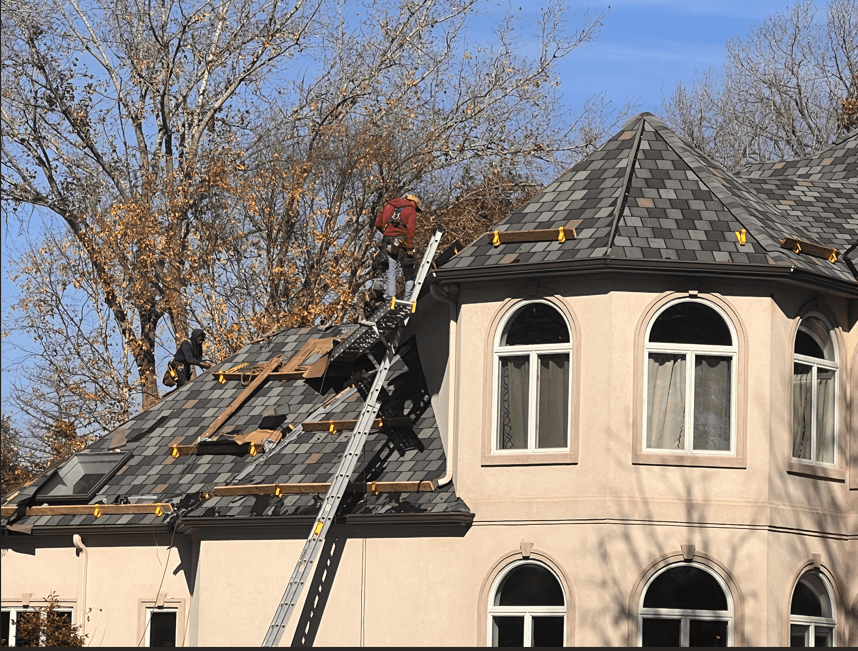
Recent Roofing Projects in Richmond, IL
Real installs from IHC crews. Photos from CompanyCam, geo-tagged in Richmond.


Richmond Roofing FAQs
How much does a new roof cost in Richmond, IL?
CertainTeed Landmark architectural shingles on a standard Richmond home run $12,000 to $22,000. Decking replacement near Nippersink Creek adds $1,500 to $3,000, and creek-corridor homes should budget for it because compromised plywood is the norm, not the exception. F-Wave synthetic ranges from $18,000 to $32,000. Brava composite sits at $20,000 to $38,000. Glacier Lake Estates custom builds with complex rooflines land at the higher end of each range. Every component is itemized before you commit. See our cost guide for full material breakdowns.
Does Richmond require a roofing permit?
Yes. Richmond operates under McHenry County building codes, and roofing permits go through Village Hall at 5600 Hunter Drive. We handle the full permit process: application, fee, inspection scheduling, and Lead Paint Certification for homes built before 1978 in the historic downtown core. You don’t interact with the building department. Village Hall’s phone is (815) 678-4040 for independent verification.
Why does Richmond get more storm damage than other McHenry County towns?
Geography. Richmond is the northernmost city in the county, pressed against the Wisconsin border, sitting on flat agricultural terrain at 784 feet with minimal natural windbreak. Storm systems building over the plains reach Richmond at full intensity before encountering the tree cover and suburban density that slow them down by the time they hit Crystal Lake or Woodstock. Nippersink Creek adds a moisture corridor that concentrates storm energy. The combination means higher wind loads, more direct hail exposure, and accelerated material degradation between storm events.
What roofing material works best near Nippersink Creek?
Start with InnoMAXX. Full-deck ice and water shield, not just eave-line coverage. Synthetic underlayment. Premium ridge vent sized to the actual attic volume. CertainTeed Landmark PRO shingles. The creek humidity attacks decking from below while rain and snowmelt attack from above, sandwiching standard underlayment into accelerated failure. If you also want hail protection, step up to F-Wave synthetic, Class 4 impact rated, and several carriers discount your premium when it’s installed.
How long does a Richmond roof replacement take?
Most Richmond homes are finished in 2 to 4 working days. Glacier Lake Estates custom builds with steep pitches and complex geometry can stretch to 5. The historic downtown structures, the 1880s and 1890s buildings along Main and Broadway with layered materials and decades of patch work underneath, sometimes need an extra day for decking discovery and sheathing replacement. Your roof is never exposed overnight. The exact timeline is part of your written proposal.
Should I replace my roof before selling my Richmond home?
Richmond’s homeownership rate is 55.4%, the lowest in our service area, which means a significant share of the market is landlords and investors. Buyers here are calculating ROI with precision. A new roof backed by a transferable 50-year SureStart PLUS warranty removes the biggest negotiation lever a buyer’s inspector can hand them. On a $225,800 median-value home, avoiding a $15,000 to $20,000 buyer credit negotiation is simple math. On a $775,000 Glacier Lake Estates listing, a premium roof is table stakes.
Roofing Services Across McHenry County
Richmond Rebuilt From Ashes in 1902. Your Roof Shouldn’t Have To.
The northernmost village in McHenry County absorbs storm systems at full force before they reach anyone else. Nippersink Creek pumps humidity into every structure within a half mile. Housing stock ranges from 1840s landmarks to 2000s luxury estates. Whether you’re staring at a historic downtown home on its fourth roof, a post-war ranch with a failing low-pitch system, or a Glacier Lake Estates custom build surrounded by Conservation District trees, the inspection costs nothing and the answer is honest.
Zero-cost inspections • GreenSky financing • IHC Public Adjusters, separately licensed IL firm (215 ILCS 5/1575)
Innovative Home Concepts
4410 IL-176, Ste 1
Crystal Lake, IL 60014
(~25 min south of Richmond via Rte 31 to Rte 12)
Phone: (815) 356-9020
Text: (815) 356-9020
Email: info@innovativehomeconcepts.com
Monday–Friday: 9:00 AM – 4:00 PM
ShingleMaster, CertainTeed’s ShingleMaster credential
IL Roofing License #104.015093
IHC Public Adjusters, Separately Licensed IL Firm
A+ BBB • Best of Fox since 2011 • Wilborn Family Since 2005
More Options for Richmond Homeowners
Other Services in Richmond
Siding in Richmond→Windows in Richmond→Gutters in Richmond→Storm Damage in Richmond→
Roofing in Nearby Cities
Roofing in Spring Grove→Roofing in Wonder Lake→Roofing in Johnsburg→Roofing in McHenry→