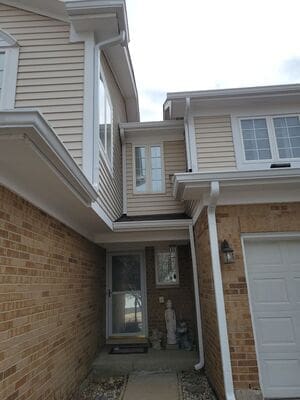
Seamless aluminum gutters formed on-site to your exact roof dimensions. 5-inch and 6-inch K-style profiles, .027 and .032-gauge aluminum, 30+ color options. No seams along the runs means no leak points — just water moving from roof to ground the way it should.
Seamless On-Site Forming • 21+ Years in McHenry County • Family-Owned Since 2005
Your Gutters Are Doing More Than You Think — Or Failing To
Your old sectional gutters have leaks at every joint. Every spring you’re emptying a wet basement or watching water pool against the foundation. The downspouts are bent from the last ice storm. And the front-elevation gutter has sagged so much it’s holding standing water most of the year. You know it’s time, but you’re not sure what actually matters in a replacement — or what questions to ask the next three contractors who knock on your door.
Modern residential gutters are seamless: we roll the aluminum on-site using a portable forming machine, cut each run to the exact length of your roof edge, and install it as a single continuous piece. No seams along the run means no leak points. 5-inch K-style is the standard profile for most McHenry County homes; 6-inch K-style handles higher water volumes from larger roof planes or heavier rain capacity. Aluminum thickness matters too: .027 gauge is standard, .032 is heavier-duty for ice exposure or longer runs. Color choice at order: 30-plus baked-enamel options to match siding and trim exactly.
What Actually Matters in a Residential Gutter Install
Most gutter failures aren’t about the gutter itself — they’re about the install details. Pitch, hanger spacing, downspout sizing, miter quality. Here’s what we pay attention to on every residential job.
Seamless On-Site Forming — Zero Joints Along the Run
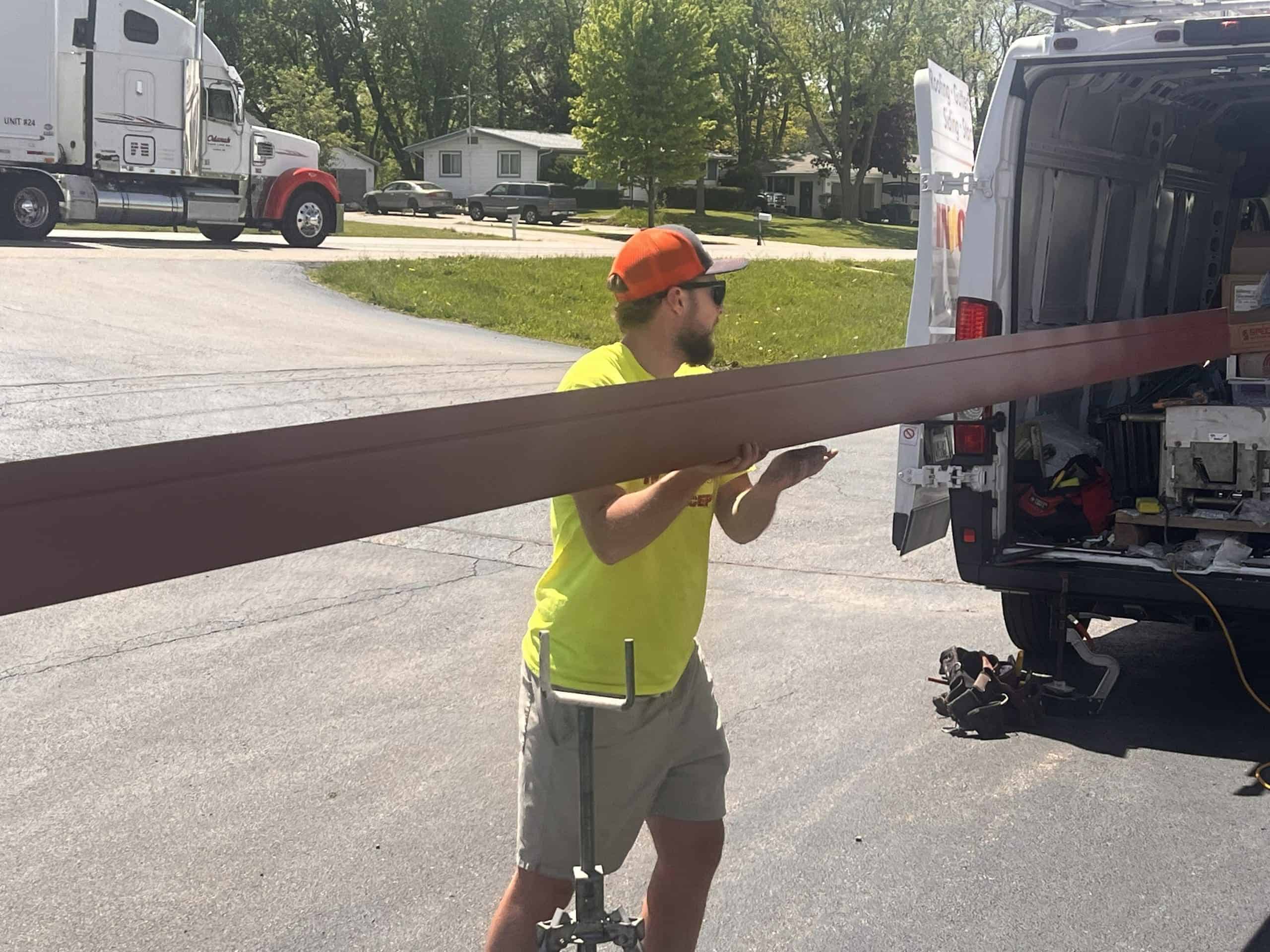
We bring a portable gutter-forming machine to every residential job. The machine rolls continuous aluminum stock into K-style profile right on the truck, and we cut each run to the exact length of your roof edge — typically 40 to 80 feet per run on a standard house. That means zero seams along the gutter run. The only joints are at corners (mitered, sealed with industrial gutter sealant) and at downspouts. Sectional gutters from a big-box store come in 10-foot pieces that have to be joined every 10 feet, creating 5 to 8 seams per run — and every seam is an eventual leak point.
Seamless is what every reputable gutter contractor in McHenry County has been installing for 20-plus years. It’s the baseline. What varies between contractors is what happens next.
Pitch, Hanger Spacing, and Downspout Sizing
Pitch: the gutter needs to slope toward the downspout at approximately 1/4 inch per 10 feet of run. Too flat and water sits in the gutter (breeding mosquitoes, freezing in ice dams); too steep and the gutter looks wrong against the eave line. We set pitch with a laser level on every run. Hanger spacing: no more than 24 inches on center for aluminum hidden-hangers (we run 18-inch on center on larger gutters and in heavy snow load areas). Widely spaced hangers let gutters sag under ice and water weight. Downspout sizing: 2×3-inch downspouts for 5-inch gutters, 3×4-inch for 6-inch gutters — sized to the volume of water the gutter moves.
I walk every residential install with the lead installer before the crew starts. We pitch-check, hanger-spec, and downspout-size by elevation. It takes an extra 20 minutes on a typical job and eliminates the callbacks that commodity gutter installs generate 2 to 3 years in.
Miters and Endcaps — Where Cheap Installs Fail
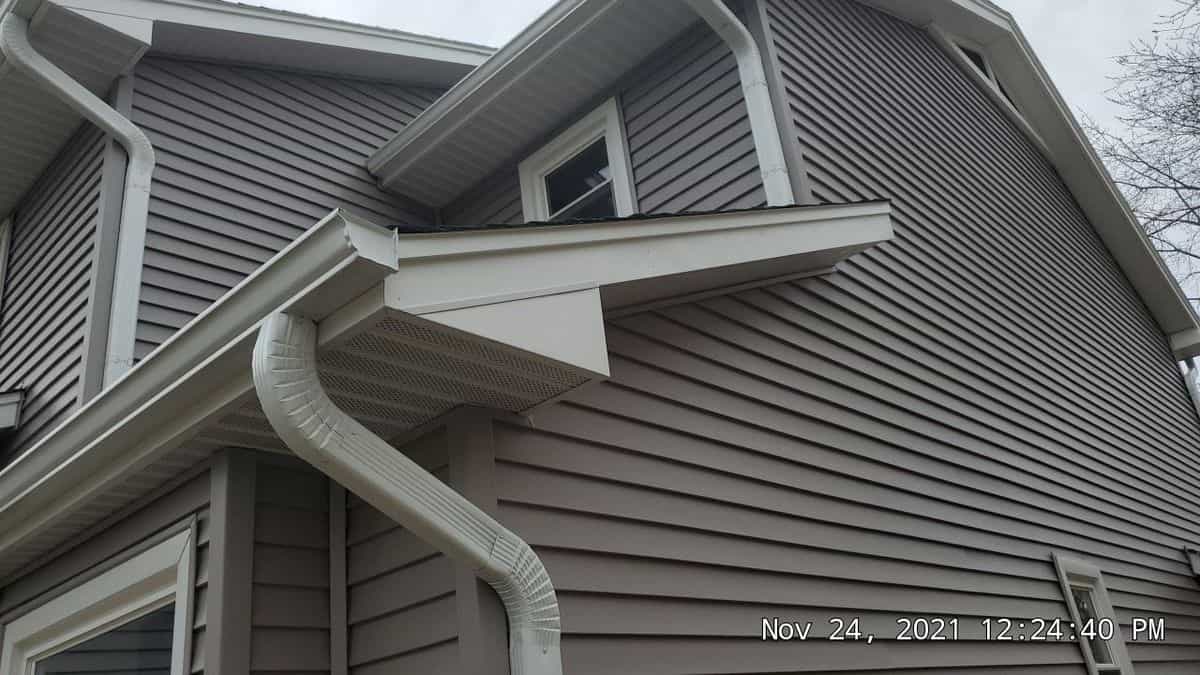
Every inside and outside corner on your roof edge gets a mitered gutter joint. Cheap installs use stamped corner pieces that get riveted in. Those corners leak in 3 to 5 years because rivets loosen and sealant fails. We hand-miter every corner on-site, cutting the aluminum to fit the exact angle of the roof, riveting with stainless fasteners, and sealing with industrial-grade gutter sealant (not the consumer silicone from the hardware store). Endcaps are the same story: fit, rivet, seal.
If you want to see the difference, look at a 10-year-old commodity gutter system at any corner — you’ll see the streak of water staining down the wall below. The corner is leaking. The rest of the run is fine. That corner failure is what we prevent with proper mitering.
Gutter Guards — If You Have Trees, You Need One
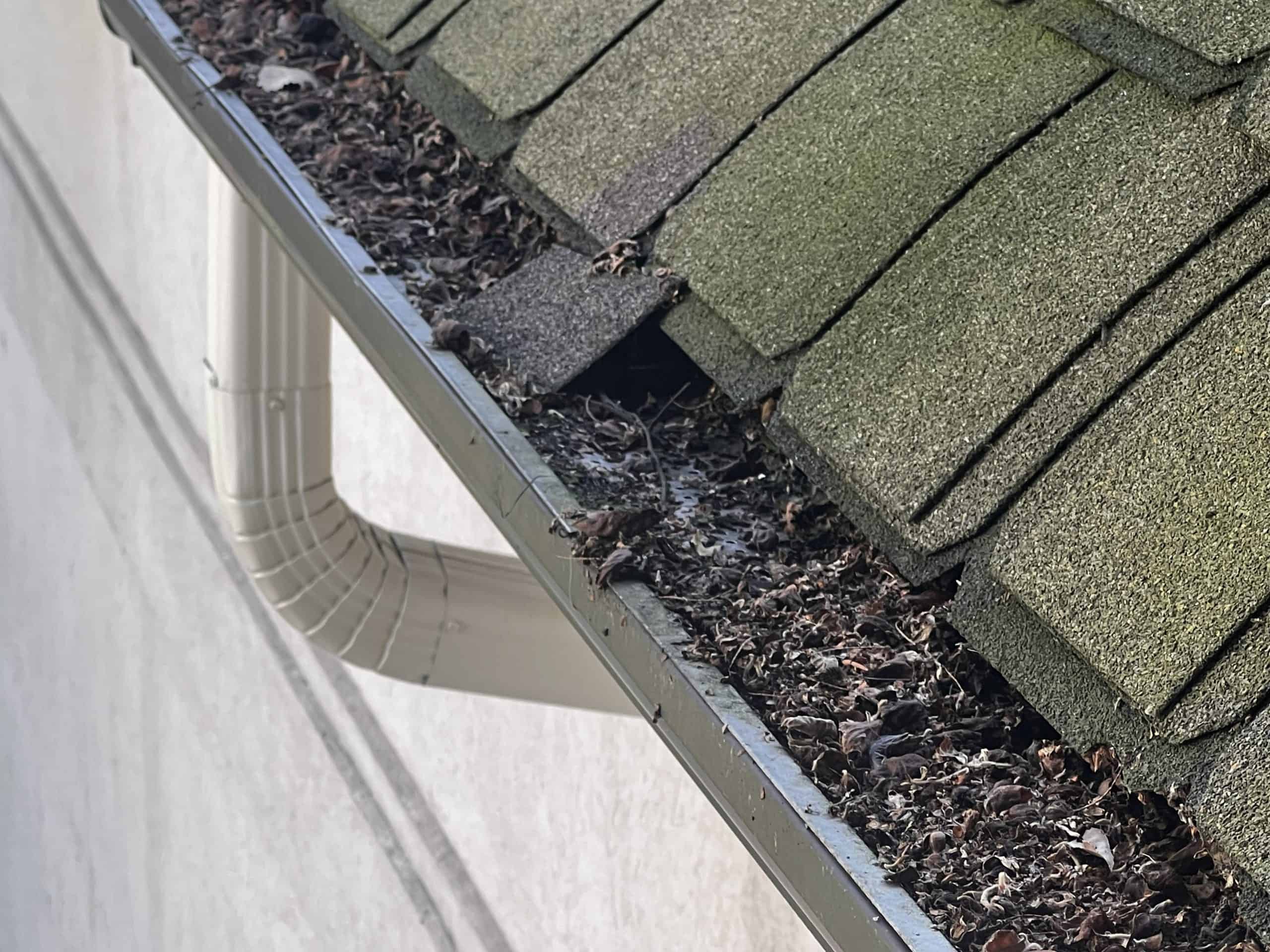
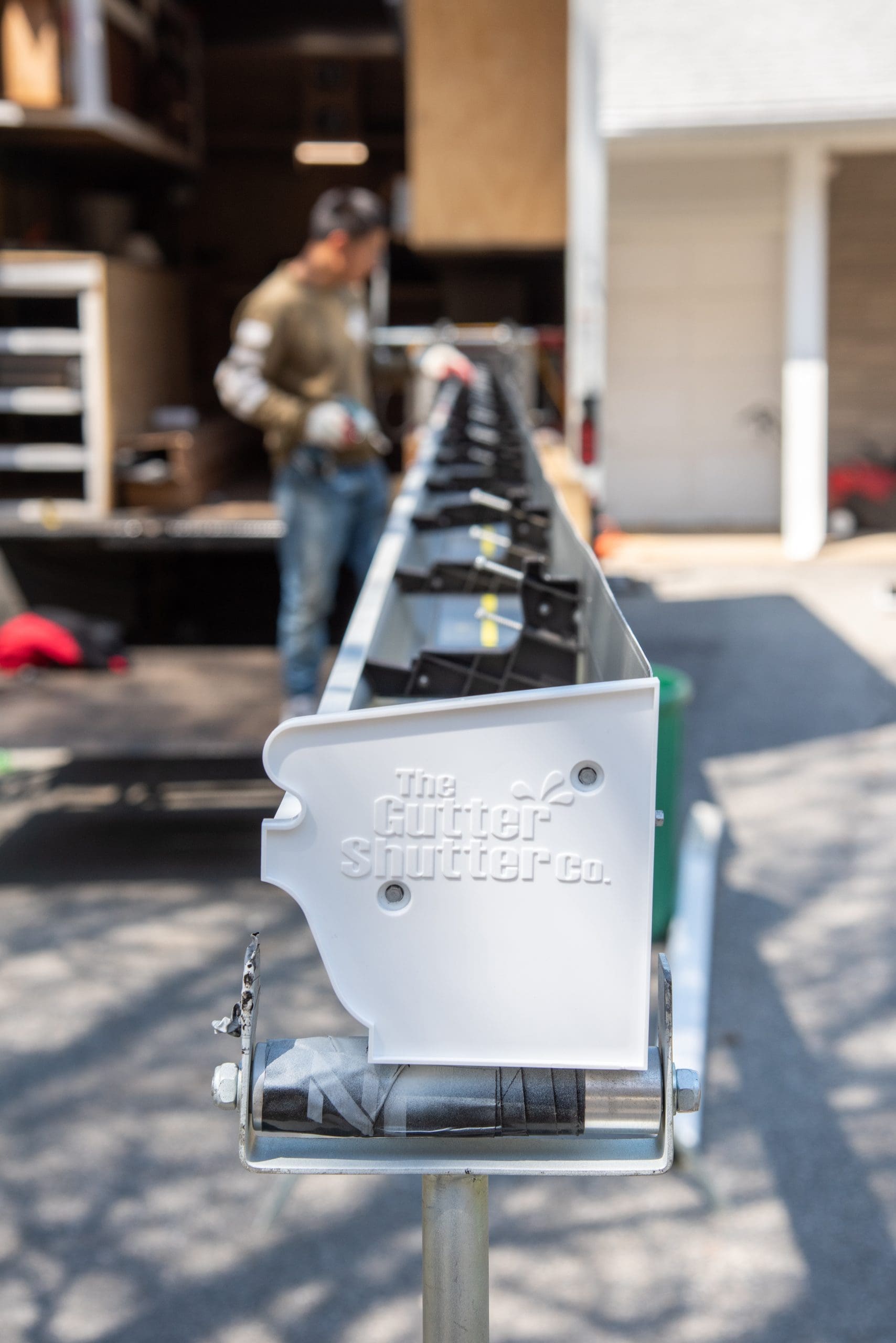
If there’s an oak, maple, birch, or pine tree within 30 feet of your house, you’ll be cleaning gutters twice a year or living with overflow every time it rains. We install two gutter guard systems on residential gutters: Raindrop (micro-mesh retrofit, installs on your new or existing 5/6-inch gutters) and GutterShutter (full system replacement, one-piece aluminum gutter-and-hood, lifetime no-clog warranty). Raindrop is the mid-range solution for most homeowners. GutterShutter is the permanent solution for homes under heavy tree canopy.
We don’t push a single solution on every house. I’ll walk the property, look at the trees, the roof, the existing gutter condition, and the homeowner’s budget — then recommend Raindrop, GutterShutter, or no guard at all. Some homes legitimately don’t need guards.
See Residential Gutters Installed by IHC
Real projects across McHenry County. No stock photos.
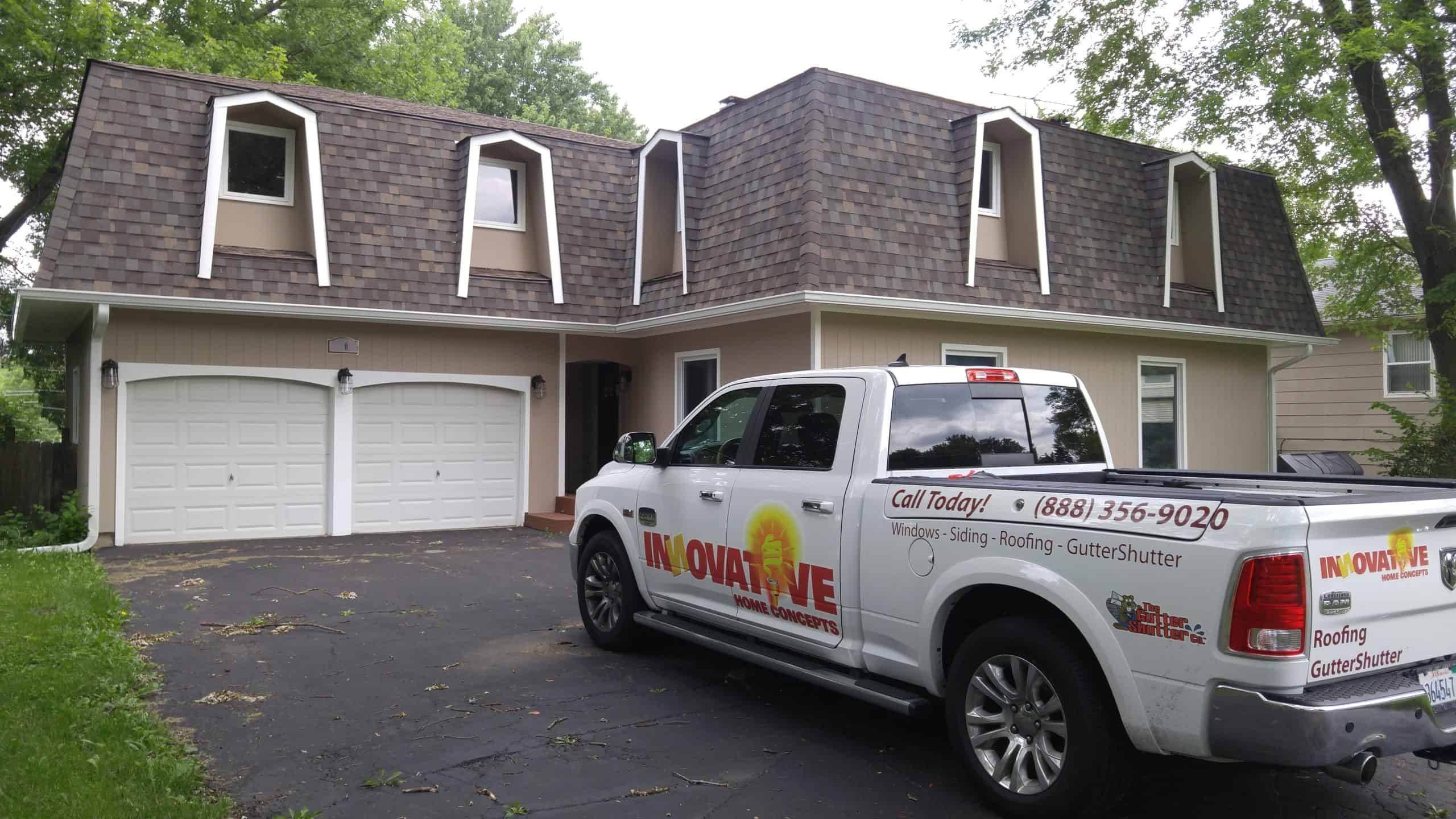
Finished residential install — McHenry County, IL
IHC crew at work
Install day — McHenry County, IL
Algonquin, IL
Woodstock, IL
Showroom samples — Crystal Lake, IL
Gutter Specs — What We Install
Every residential gutter install is a spec decision. Here’s the menu.
5″ K-Style
Standard for most McHenry County homes. Pairs with 2×3 downspouts.
6″ K-Style
Larger capacity for big roof planes or heavy-rain exposures. Pairs with 3×4 downspouts.
Half-Round
Traditional profile for historic Victorian, Craftsman, and colonial-era homes.
.027 Gauge
Standard aluminum thickness. Appropriate for most residential jobs.
.032 Gauge
Heavier-duty aluminum. Recommended for long runs, ice exposures, heavy snow load.
30+ Colors
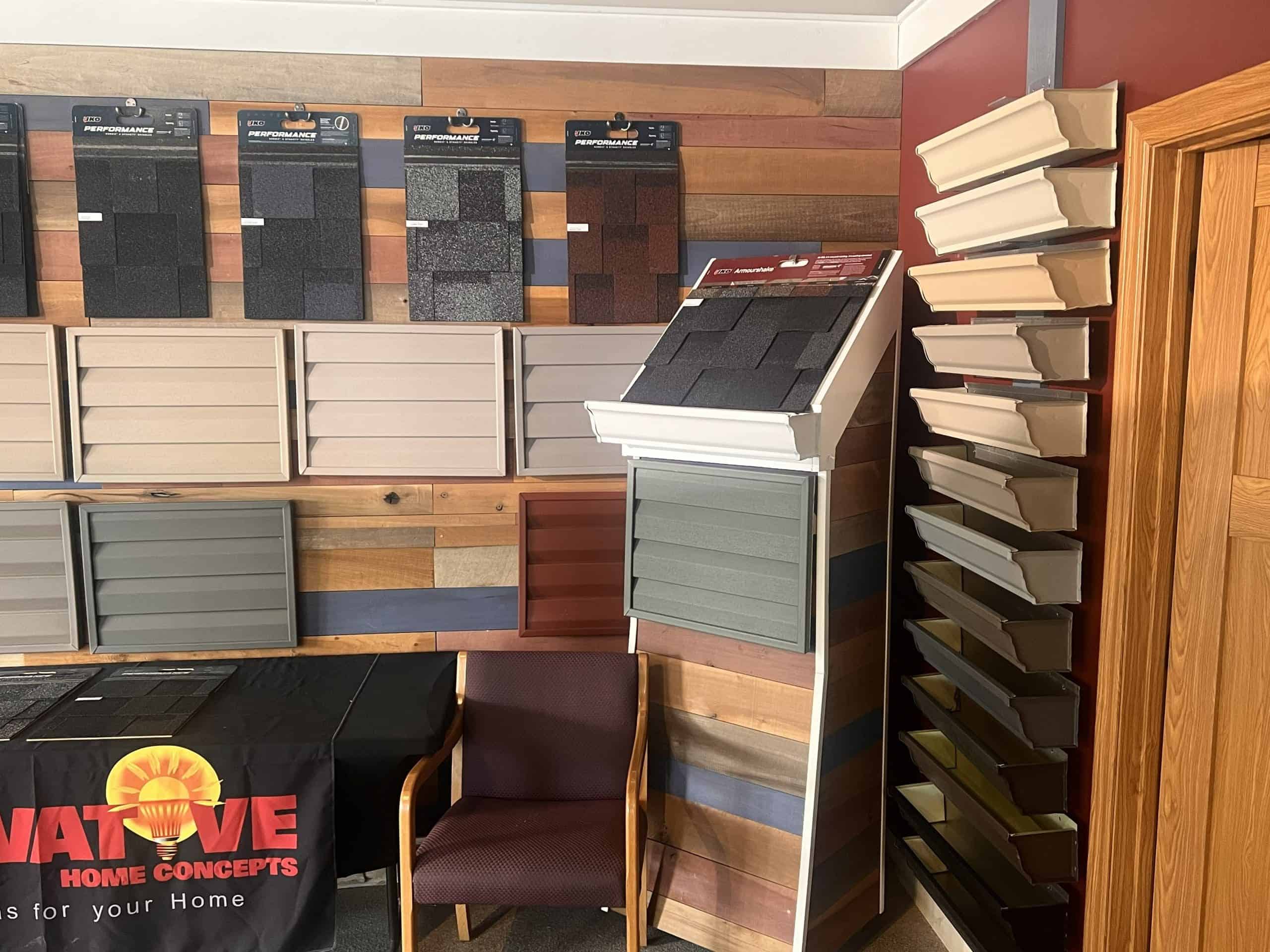
Baked-enamel finish. White, cream, browns, grays, bronze, black, plus custom match.
Standard install spec: 5-inch K-style in .027 gauge with 2×3 downspouts, hidden hangers at 24-inch on center, 1/4-inch per 10 feet pitch, mitered corners with stainless rivets and industrial sealant. Gutter color matched to existing siding or trim. See color samples at our Crystal Lake showroom.
Gutter Install Tiers We See in McHenry County
Not every gutter install is equal. Here’s the honest comparison of the three tiers we see bid on residential jobs.
| Feature | IHC Seamless Install This Page | Commodity Seamless | Big-Box Sectional (DIY) |
|---|---|---|---|
| Seamless Run | Yes — on-site formed | Yes | No — 10-foot pieces with seams |
| Pitch Setting | Laser-leveled every run | Eyeballed | Homeowner guesses |
| Hanger Spacing | 24″ max (18″ on heavy runs) | 36″+ often | N/A |
| Miters | Hand-cut, riveted, sealed with industrial sealant | Stamped corner pieces riveted in | Stamped pieces with consumer caulk |
| Downspout Sizing | Matched to gutter size and run length | Standard 2×3 regardless | One-size-fits-all |
| Crew Training | Lead installer walks every job pre-start | Varies — depends on contractor | N/A (homeowner install) |
| Warranty | Long-term workmanship | Typically 1-year installer | None |
| Typical Failure Point | Rare — guards are the usual add-on | Corner leaks 3-5 years in | Seam leaks 1-3 years in |
Why Buy Residential Gutters Through IHC
Gutters Are the Unsung Hero of the Exterior
Most homeowners don’t think about gutters until they’re failing — water pooling at the foundation, basement leaks, ice dams on the roof, sagging runs. By that point you’re replacing gutters because the old ones caused thousands of dollars in other damage. Done right, gutters are the exterior component you forget about. Water runs off the roof, into the gutter, down the downspout, away from the foundation. That’s it. No basement leaks, no ice dams, no soffit rot, no mosquito breeding in standing water.
IHC has installed residential seamless gutters across McHenry County since 2005. Our crews run a portable forming machine on-site, pitch-check every run, mitered corners, stainless fasteners, industrial sealant. We install Raindrop and GutterShutter gutter guards on the same visit when the tree canopy calls for it. 21-plus years in McHenry County, 400-plus Google reviews at 4.6 stars, A+ BBB. We’re the gutter contractor you call once, not every 7 years.
21+
Years in McHenry County
400+
Google Reviews at 4.6 Stars
A+
BBB Rating
Family
Women-Led, Locally Owned
Notes From the Field — What We Actually Install
I’ve been installing residential gutters in McHenry County since 2005. Our most common residential order is 5-inch K-style in .027 gauge with 2×3 downspouts, hidden hangers at 24-inch on center, color-matched to trim. We’ve installed gutters on ranches in Country Club Estates, two-story colonials along the Fox River corridor, split-levels in Cary, farmhouses in Woodstock, and lake homes across the county. The product is consistent; the install quality is what varies between contractors.
Details we don’t skip: laser-leveled pitch at 1/4 inch per 10 feet toward the downspout. Hanger spacing at 24 inches on center for most runs, tightening to 18 inches for runs over 40 feet or in heavy snow areas. Corner mitering on every inside and outside corner — hand-cut, stainless riveted, industrial-grade gutter sealant applied at the seam. Downspout sizing matched to gutter capacity (2×3 for 5-inch gutters, 3×4 for 6-inch). Splash blocks or underground drainage at every downspout termination to move water 4 to 6 feet from the foundation.
For homeowners with trees, I’ll walk through Raindrop vs GutterShutter in the consultation. Raindrop is micro-mesh that installs on your new 5/6-inch gutters — mid-range investment, handles most tree canopy situations, stays functional through McHenry County winters. GutterShutter is a full gutter-and-hood replacement with lifetime no-clog warranty — permanent solution for homes under heavy tree canopy or where the homeowner is done climbing ladders. Not every home needs a guard. I’ll tell you if yours doesn’t.
A few more residential gutter install specifics I’ll share from McHenry County field work. Our standard 5-inch K-style install uses .027-gauge aluminum on 85 percent of jobs, upgrading to .032-gauge on 15 percent where the run exceeds 45 feet, the snow load history calls for extra thickness, or the homeowner wants the heavier gauge for peace of mind. Hidden hangers at 24-inch on center is our default; we tighten to 18-inch on runs over 40 feet long or on north-facing elevations with heavy ice accumulation. Our most common downspout configuration is 2 downspouts per 40-to-50 feet of gutter run, with 2×3-inch downspouts on 5-inch gutters and 3×4-inch downspouts on 6-inch gutters. I spec downspout counts based on drainage-area calculation — every 600 square feet of contributing roof area should have its own downspout.
On color selection, I’ve seen a few trends dominate 2025 and 2026 residential work. Bright White and Pearl Gray are the color volume leaders across colonial and ranch homes, especially paired with dark-trim aesthetics. Musket Brown and Cocoa are gaining ground on Craftsman and farmhouse projects where the gutter has to read as a trim accent rather than disappear. Bronze and Black are our dark-tier favorites for modern and contemporary builds. I’ll bring color samples to every in-home consultation so you hold the gutter color up against your actual siding and trim in actual sunlight before you decide — picking from a brochure never matches what you’ll see installed.
Other IHC Gutters Products We Install
Every gutter service IHC offers in McHenry County — residential and commercial new gutters, plus the two gutter guard systems we install. We don’t push a single solution on every home; we recommend based on the tree canopy, the gutter condition, and the budget.
IHC Gutters
Commercial Gutters
Industrial-gauge aluminum, box-style, apartments + commercial
Explore →
IHC Gutters
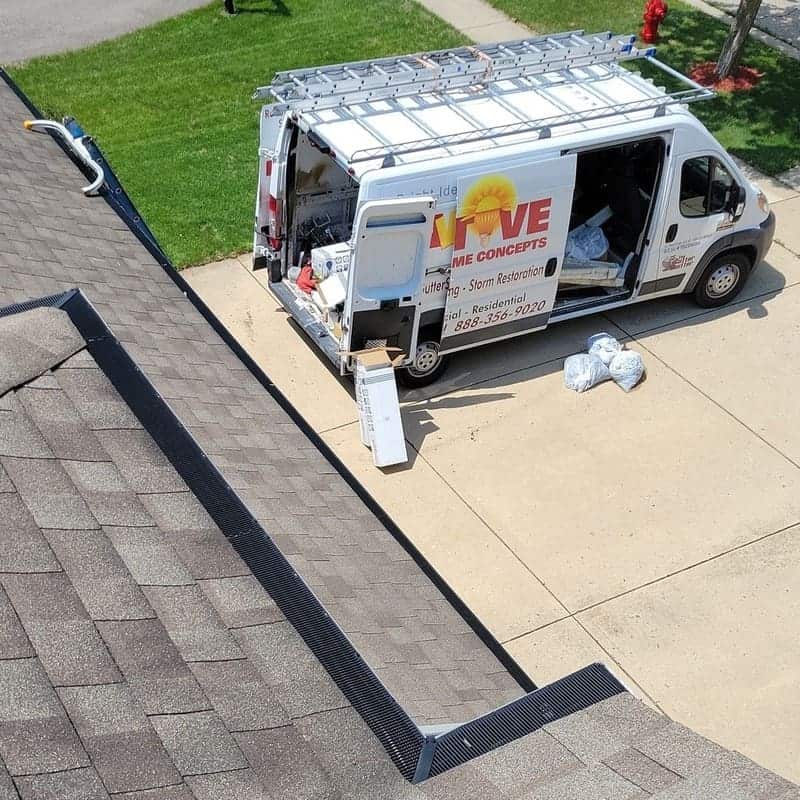
Raindrop Gutter Guards
Micro-mesh retrofit, works on existing gutters
Explore →
IHC Gutters
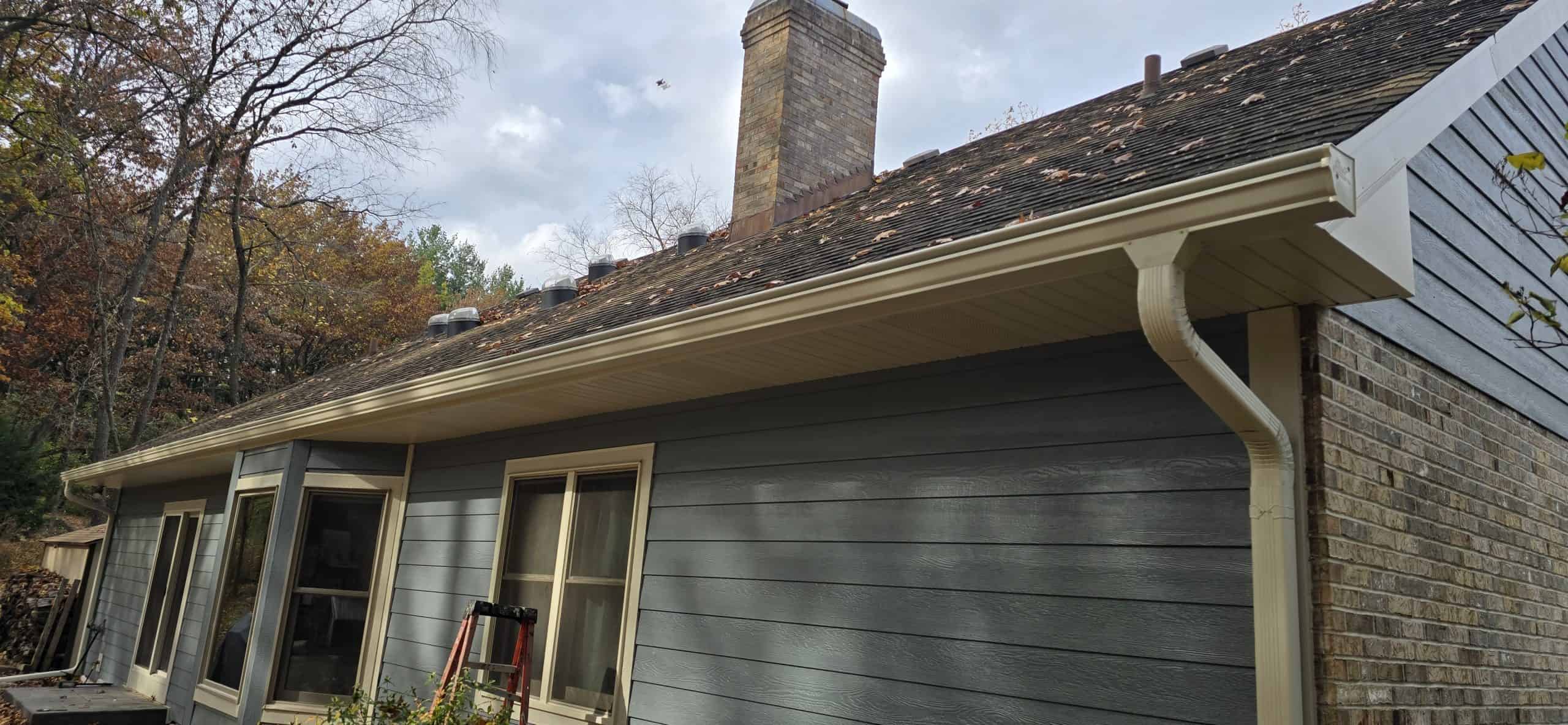
GutterShutter
Full replacement, 22"/hr capacity, lifetime no-clog
Explore →
More About Gutters
Ready to Install Gutters You Won’t Think About?
We come to your home, walk the elevation, measure every run, discuss gutter guards if the tree canopy calls for it, and give you a free estimate for the complete seamless gutter system. No pressure, no obligation.
Visit Our Crystal Lake Showroom
4410 IL-176, Suite 1, Crystal Lake, IL 60014
Mon–Fri 9AM–4PM | Appointments available 24/7 via AI receptionist
400+ Google Reviews · 4.6 Stars · Family-Owned Since 2005
Frequently Asked Questions
Is seamless really better than sectional?
Yes — by a wide margin. Seamless gutters are formed on-site as single continuous pieces per roof edge, typically 40 to 80 feet per run. Sectional gutters from big-box stores come in 10-foot pieces that have to be joined every 10 feet. Each seam is an eventual leak point. On a 60-foot run, that’s 5 potential failure points on sectional versus zero on seamless. Every reputable gutter contractor in McHenry County has been installing seamless for 20-plus years. Sectional is strictly DIY-tier.
5-inch or 6-inch gutters — which do I need?
5-inch K-style is standard for most McHenry County homes — handles the water volume from typical residential roof planes. 6-inch K-style is the upgrade for larger roof planes (over 2,000 square feet of contributing area), heavy-rain exposures, or homes where the existing 5-inch gutters were undersized and overflowing during storms. 6-inch requires 3×4 downspouts (vs 2×3 for 5-inch). We’ll measure the contributing roof area during the consultation and recommend appropriately.
How long do seamless gutters last?
A properly installed aluminum seamless gutter system should last 20-plus years, often 30 with minimal maintenance. The failure modes are: sagging (caused by wide hanger spacing or insufficient structural support), corner leaks (caused by poor mitering and cheap sealant), downspout issues (caused by undersized or bent downspouts), and ice damage (can bend gutters if ice dams form). Install quality and hanger spacing determine lifespan more than the aluminum gauge.
Do I need gutter guards?
Depends entirely on your tree canopy. If there’s an oak, maple, birch, or pine within 30 feet of the house, you’ll be cleaning gutters twice a year minimum without guards. If the closest tree is 50-plus feet away, you probably don’t need guards at all. We install Raindrop (micro-mesh retrofit) and GutterShutter (full replacement system with lifetime no-clog warranty). I’ll walk your property and recommend honestly — including not recommending guards if your situation doesn’t warrant it.
What colors do seamless gutters come in?
30-plus baked-enamel color options including white, cream, browns, grays, bronze, black, and specialty colors like Hunter green and Colonial red. We can also custom-match to your siding or trim color if none of the standard colors hit exactly. Color decision happens at the consultation — we bring color samples to hold up against your house so you see the match in your actual light.
What’s the difference between K-style and half-round gutters?
K-style is the standard modern profile — flat back, decorative curved face, matches contemporary and traditional home styles. Half-round is an older profile (actually half of a round pipe) that fits historic homes — Victorian, Craftsman, colonial-era where the decorative K-style face would look wrong. Half-round is more expensive and harder to source. Most McHenry County residential jobs use K-style; we’ll specify half-round on historic restorations where the architecture calls for it.