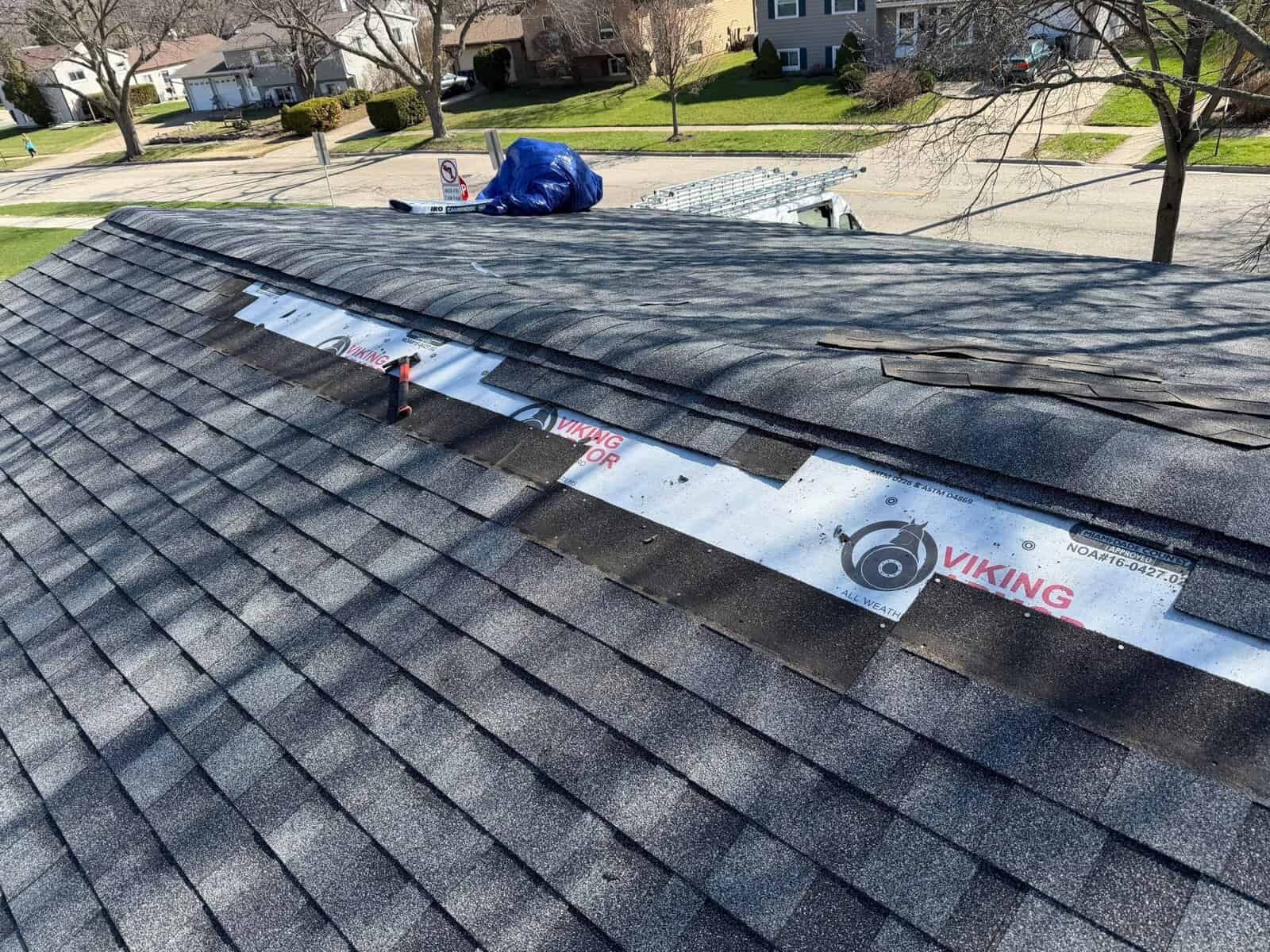
60 mph winds ripped these shingles right off the deck.
If you’re reading this, your home might have just taken a hit.
Need expert advice on your project?
21 years in McHenry County · Free estimates · No pressure
On April 3rd, a wind storm tore through McHenry County. 60 mph gusts. A tornado warning. A home’s foundation collapsed on West South Street in McHenry — a family of five had to evacuate. Power lines came down near Route 120 and Bull Valley Road. 1,200 homes lost power. The Northwest Herald covered it, and the National Weather Service confirmed three tornadoes across northern Illinois that night.
And that’s just the wind. Last year, a hail storm ripped through Cary — we’re still working those insurance claims and roof replacements right now. The south suburbs just got hammered with a major hail event too. This stuff doesn’t stop. If you live in McHenry County, it’s not a question of if your home takes a hit. It’s when.
I’ve been doing this for 21 years at the same address in Crystal Lake. Storms rip through here constantly. And every single time, I watch the same thing happen — good people make bad decisions because they’re scared and don’t know what comes next.
So here’s the playbook. What to do, what not to do, and how to make sure you don’t get taken advantage of in the process.
5 Manufacturer Certifications
Ready to get it done right the first time?
Andersen Elite Certified · James Hardie Select · LP SmartSide Certified · GutterShutter Exclusive Dealer
Don’t Panic, But Don’t Wait Either
I’ll be straight with you — the first 48 hours after a storm are the most important 48 hours of your entire claim. What you do right now determines whether your insurance company writes you a fair check or lowballs you into the ground.
First thing: grab your phone and start taking pictures. Everything. The yard, the roof from the ground, your gutters, your siding, your windows. If there’s hail on the ground, put a quarter next to it and photograph it before it melts. I can’t tell you how many homeowners I’ve worked with in Coventry and Crystal Lake Estates who didn’t document the hail — and then the adjuster shows up three weeks later acting like nothing happened.
Before you touch anything or move anything, document it. I mean it. Don’t sweep up debris. Don’t pull branches off the roof. Don’t try to tarp anything yet. Photos first.
Now — safety. This matters more than your roof.
- Downed power lines: Stay away. Call ComEd at 1-800-334-7661. I drove down Route 176 after the April 3rd storm and saw lines draped across driveways in two different spots. Those will kill you.
- Gas smell: Get out of the house. Call Nicor at 888-642-6748 from outside.
- DO NOT climb on your roof. Wet shingles after a storm are like walking on ice. I’ve had customers tell me they went up with a ladder to “just take a look” and ended up in the ER. It’s not worth it.
What Storm Damage Actually Looks Like (Most of It You Can’t See)
Here’s the thing most people don’t realize: you can stand in your driveway, look up at your roof, and think it looks fine. It’s not fine.
Hail damage on a roof doesn’t look like holes punched through shingles. It looks like dark spots — little bruises where the hail cracked through the granule layer and exposed the fiberglass mat underneath. You can’t see that from 30 feet below. You need someone on the roof with their hands on the shingles to find it.
Here’s what we actually look for during a storm damage inspection:
Roof
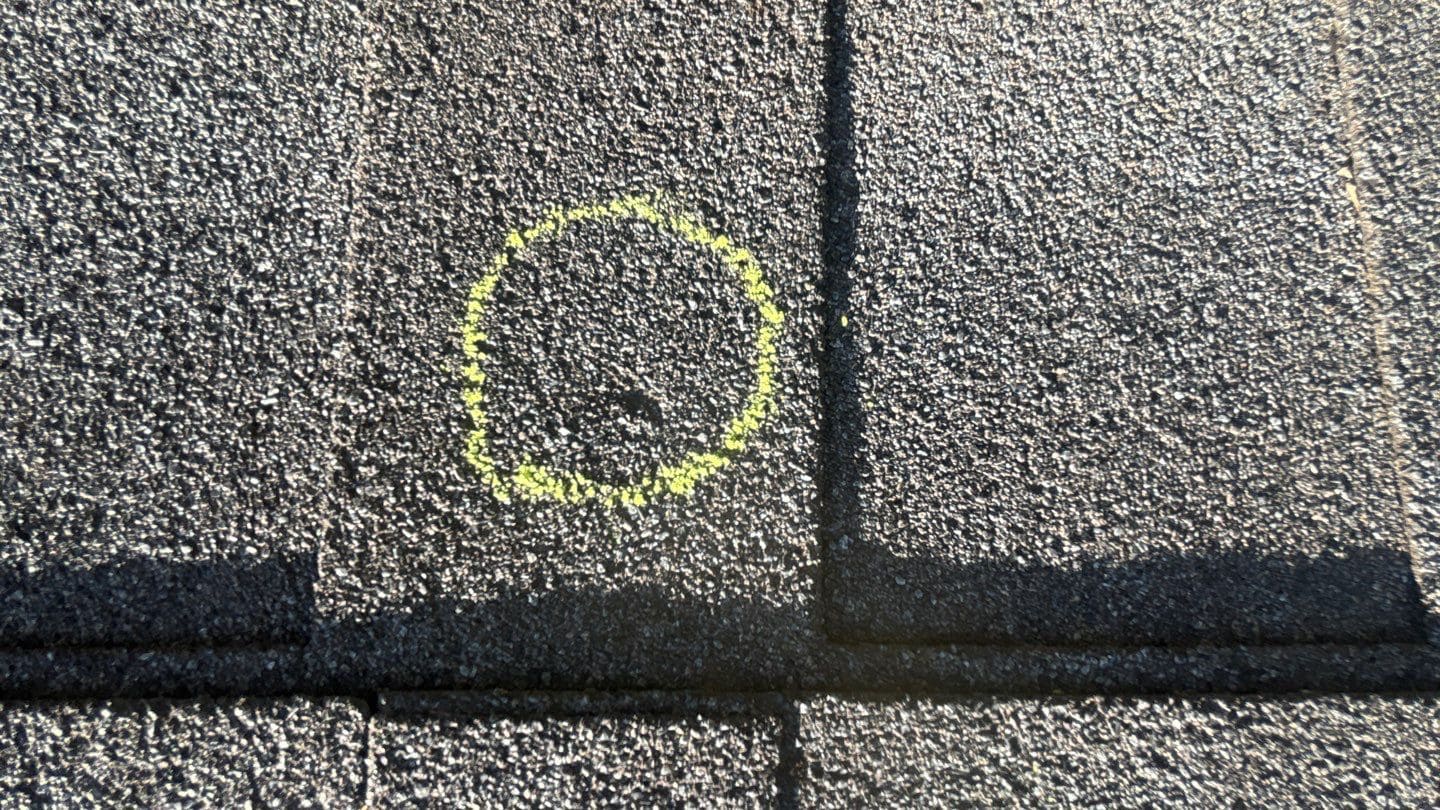
Hail damage on an asphalt shingle — that dark spot is exposed fiberglass mat. You can’t see this from the ground.
Dark spots on shingles where granules got knocked off. Granule buildup sitting in your gutters (that gritty sand-like stuff). Dented or cracked pipe boots and flashing. Damaged ridge vents. If you’ve got a cedar shake roof, you’re looking at split shakes and lifted sections — cedar takes storm damage differently than asphalt.
Siding
Dents in vinyl and aluminum are obvious. Cracks in fiber cement are harder to spot but worse long-term — water gets behind the wall. Blown-off sections mean your house wrap is exposed and you’re on a clock before moisture gets in.
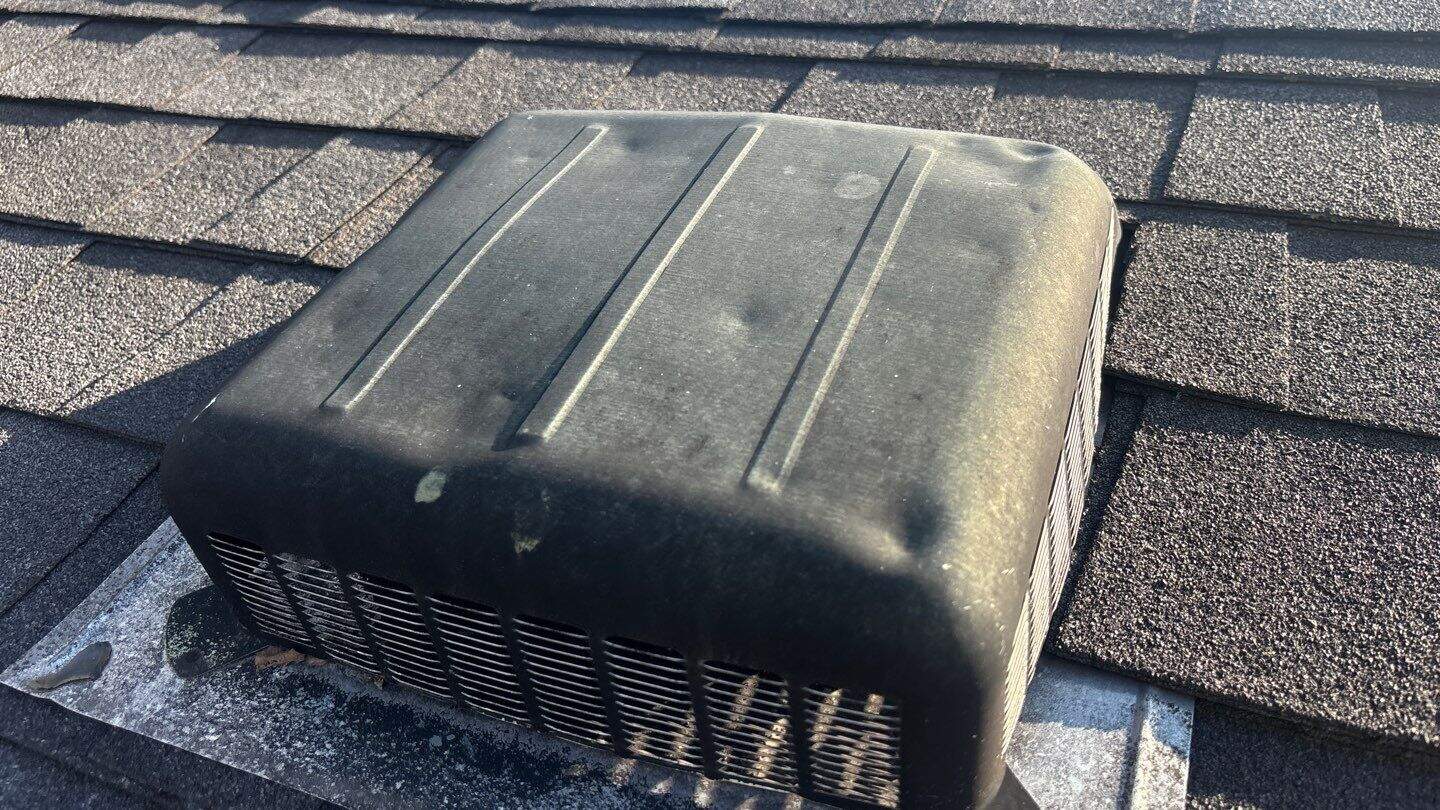
Hail damage to a roof vent — the dents are obvious on metal but the shingle damage around it is just as bad.
Windows and Gutters
Cracked glass is easy to see. Broken seals aren’t — but they’ll show up as foggy double-pane windows in a few weeks. Torn screens. Gutters: dented, sagging, pulled away from the fascia, crushed downspouts. All of it matters for your claim.
Real talk? After the April 3rd storm, I personally inspected a home off Walkup Avenue where the homeowner swore his roof was fine because he couldn’t see anything from the ground. We found 47 hail strikes on the south-facing slope alone. Full replacement.
The Insurance Call — What to Say (And What NOT to Say)
This is where people blow it. And I mean blow it badly.
Call your insurance company within 48 hours. Have your policy number ready. Get a claim number. Ask them when the adjuster is coming out. That’s the call.
Now here’s what you do NOT do:
- Do NOT agree to a recorded statement on the first call. They’ll ask. You can decline. You’re not obligated.
- Do NOT speculate about cost. Don’t say “I think it’s going to be around $15,000” — you just set a ceiling on your own claim.
- Do NOT accept a phone settlement. If they offer to settle over the phone without ever sending an adjuster to your property, that’s a red flag the size of Texas.
- Do NOT guess about the extent of damage. Say “I’m still assessing” and leave it at that.
You know what makes the biggest difference? Having documentation that speaks the insurance company’s language. That means Xactimate — it’s the pricing software insurance companies use to scope claims. When your contractor’s documentation matches their format, nothing gets lost in translation. No vague estimates. No “we think it’s about this much.” Line items they can’t argue with.
And if your claim gets lowballed — which happens all the time — you have options. Our sister company, IHC Public Adjusters, is a separately licensed Illinois public adjusting firm (financial relationship disclosed per 215 ILCS 5/1575). Tobias Wilborn is an independent licensed public adjuster with IHC Public Adjusters who advocates for homeowners — he works for you, not the insurance company. That distinction matters more than you think. The insurance company’s adjuster works for them. Tobias works for you. For more on how the insurance claim process works, we’ve got a full breakdown.
Storm Chasers vs. Real Contractors — How to Tell the Difference
How many random trucks did you see in your neighborhood the day after the storm? I’m guessing more than a few.
Every time McHenry County takes a hit, out-of-state crews flood in. Unmarked trucks, out-of-state plates, guys knocking on doors at 7 PM with a clipboard and a “free roof” pitch. It happens like clockwork.
Let me tell you what a “free roof” actually means. When someone says they’ll waive your deductible, that’s not generosity — that’s insurance fraud under Illinois law. They inflate the claim to cover the deductible, which means you’re participating in fraud whether you realize it or not. Don’t do it.
Red flags that scream storm chaser:
- No local business address (ask them — watch them dodge the question)
- Pressure to sign a contract at your door right now
- Asking for a large deposit upfront before any work starts
- Cash-only payments
- “We’ll handle everything with your insurance” without explaining what that means
- No Illinois roofing license — you can verify at idfpr.illinois.gov
What does a real contractor look like? Illinois roofing license you can verify. Million-dollar-plus insurance coverage. Manufacturer certifications — like our CertainTeed ShingleMaster status. A physical office you can walk into. Hundreds of local reviews — we’ve got 400+ Google reviews at 4.6 stars, and every single one of them is from a real McHenry County homeowner.
I’ve been at 4410 Route 176 in Crystal Lake since 2005. Same phone number. Same family. These guys show up after a storm with out-of-state plates and disappear after cashing the check. Since when is that a business model?
Why Storm Chasers Target Chicagoland Specifically
Here’s the part most homeowners never hear — straight from our owner, Rhett Wilborn, after two decades of watching it happen:
“A major storm hits the Chicagoland area and every storm chaser in the country is watching. From Texas to Ohio, companies that make their money with quick and easy insurance claim jobs are always scanning weather reports. When a sizable storm hits, it gets attention for several reasons. For one, the houses tend to be larger than some areas — bigger roofs means bigger money. Another reason is insurance pays claims based on what things cost in a geographic area, and Chicagoland pays near the top compared to other parts of the country. And finally, I believe, they love Chicagoland because of housing density. Subdivisions are the main way housing is organized here — easy to market to, canvas, and get lots of business from. So a big storm brings storm chasers like moths to light. Great for storm chasers… bad for local homeowners.”
And the model itself is built to leave:
“Many, if not most, of these companies are in it for the smash and grab. They sweep into town for the initial two or three months of the storm, grab as many claims as possible, hurry up and get as much work done as fast as they possibly can, then they’re onto the next storm.”
That sweep-and-leave timeline is why three problems are baked in. The storm chaser doesn’t care about quality — they’ll be gone before the problems show up. They’ll never have to honor a warranty, again because they won’t be around. And they lean on transient labor crews to move fast, and on a roof, speed usually comes straight out of quality.
So the smartest move is simple, in Rhett’s words:
“Don’t be fooled that the insurance company is going to take care of you. You do not warranty the work the contractor does — they just pay for it. At the end of the day, it is your home. You should choose your contractor using the same criteria you’d use if you were paying your hard-earned money yourself for the work.”
What McHenry County Storms Do to Homes (And Why It Never Really Stops)
People act surprised every April when storms roll through. I don’t get it. We live here. This is what happens.
McHenry County gets hit with 60+ thunderstorms per year. Over 100 freeze-thaw cycles every winter — that’s your shingles expanding and contracting over and over until something gives. Multiple hail events every storm season. And April 3rd? That was just the opening act. Storm season runs through September.
Some neighborhoods get it worse than others. Older homes in Coventry, Crystal Lake Estates, parts of Bull Valley — those houses have roofs and siding from the late ’80s and ’90s. They were already on borrowed time before this storm hit. Woodstock took it hard this round. So did Cary and parts of Fox River Grove.
I’ve done full exterior remodels on homes in this county where the homeowner didn’t even know they had damage until a second storm caused an interior leak. By then, you’re dealing with mold, rotted decking, and a claim that’s ten times more complicated than it needed to be.
That’s why I keep saying: don’t wait. Get it inspected. Get it documented. Deal with it now while your insurance company can’t argue the damage is from something else six months later.
Frequently Asked Questions
How soon should I get my roof inspected after a storm?
As soon as possible. Every rain event after hail drives water into the exposed fiberglass mat where granules were knocked off. What starts as cosmetic damage turns into a leak — and leaks turn into mold and structural problems. Don’t sit on it.
Will my insurance cover a full roof replacement?
It depends on your policy type and the scope of damage. If you have Replacement Cost Value (RCV) coverage and the damage warrants it, yes — they should cover a full replacement minus your deductible. Actual Cash Value (ACV) policies factor in depreciation, which means a smaller payout. That’s why your documentation has to be airtight. Here’s how we help with that.
Do I have to use the contractor my insurance company recommends?
No. Absolutely not. In Illinois, you have the right to choose your own contractor. Insurance companies have “preferred vendor” lists, but those contractors work for volume — not necessarily quality. Pick someone who works for you, not someone who works for your insurance company’s bottom line.
What if my insurance company lowballs my claim?
That’s what a public adjuster is for. Tobias Wilborn with IHC Public Adjusters — our sister company, a separately licensed Illinois public adjusting firm — fights for your full payout. He reviews the scope, matches it against Xactimate line items, and negotiates directly with your insurance company on your behalf. He works for you. (Financial relationship disclosed per 215 ILCS 5/1575.)
How long does the whole process take?
Roughly 4 to 8 weeks from your first call to completed repair. The biggest variable is your insurance company — some adjusters show up in a week, some take a month. Once the claim is approved and materials are ordered, the actual roof replacement takes 1-3 days for most homes.
Don’t Wait Until the Next Storm
Look — I know this is a lot. Your house might be damaged. You’re stressed. And now you’re supposed to figure out insurance claims and pick a contractor on top of everything else.
You don’t have to figure it out alone. We’ve been doing this in McHenry County since 2005. We speak Xactimate. We know how adjusters think. And we’ll tell you the truth — even if the truth is that everything’s fine and you don’t need us.
That’s happened more times than you’d think. Not every storm means a new roof. But you won’t know until someone who knows what they’re looking at walks your entire property.
When we say free storm damage inspection, we mean the whole property. Not just the roof. We inspect the roof, siding, windows, gutters, fences, decks, and personal property for hail damage. Everything gets documented with photos. If there’s a claim worth filing, we’ll tell you. If there isn’t, we’ll tell you that too.
Call or Text (815) 356-9020 for a Free Storm Damage Property Inspection
— Rhett Wilborn, Founder & President, Innovative Home Concepts
Frequently Asked Questions
What kind of storm damage should I look for?
Look for missing shingles, dents on gutters, or granules in your downspouts. High winds and hail often cause damage you can't see from the ground, like bruising on shingles.
Should I call my insurance company first after a storm?
Get a professional roof inspection before calling insurance. You need a clear, documented assessment of the damage, not just a guess. We'll give you the facts to present.
How quickly do I need to act after a storm hits my roof?
Act fast. Wind and hail damage won't fix itself, and delaying repairs can lead to bigger problems like leaks, mold, and structural issues. Get it checked immediately.
Is all storm damage obvious from the ground?
No. Hail damage, especially, can be subtle. Dents on metal, bruising on shingles—it's not always a gaping hole. That's why a professional inspection is critical to find everything.