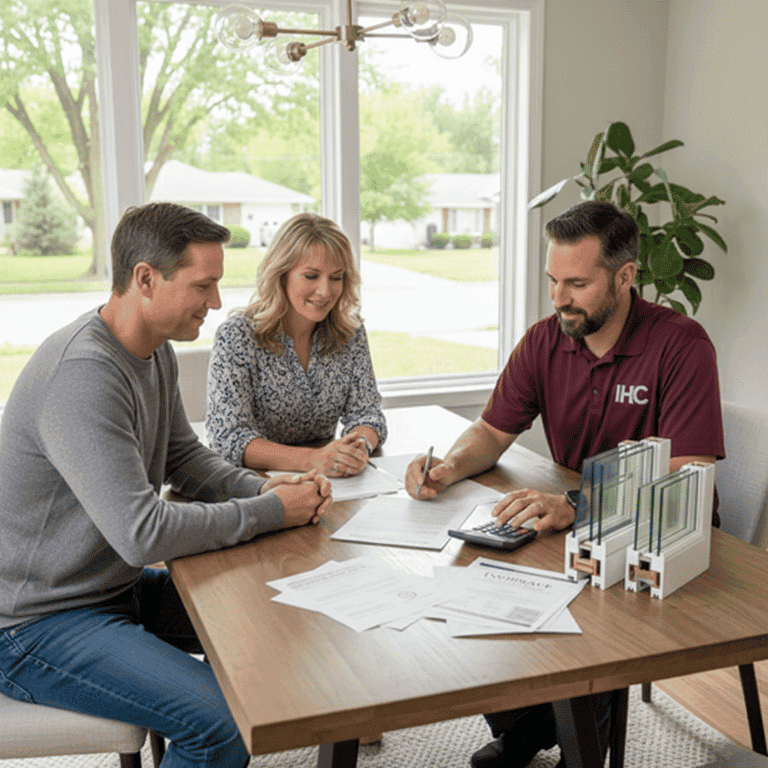
Last Tuesday, I got a call from a homeowner in Crystal Lake who was almost in tears. She’d just written a $12,000 check to a “contractor” who promised to replace all her windows within two weeks. Three weeks later, he won’t return her calls, and she’s fairly certain she’ll never see him or her money again.
This wasn’t her first rodeo with home improvement projects. She’s a successful marketing director, owns a beautiful home near Three Oaks Recreation Area, and considers herself a smart consumer. But she still got caught.
Here’s the thing—it wasn’t her fault. These scammers are professionals. They know exactly what to say, how to build false trust, and which psychological buttons to push. After twenty-three years in the window and siding business here in McHenry County, I’ve seen the aftermath of these cons more times than I care to count.
I’m writing this because I’m tired of getting those calls. I’m tired of watching good people lose their hard-earned money to criminals who prey on homeowners trying to improve their homes. And I’m especially tired of knowing that the warning signs were there—but nobody taught these homeowners what to look for.
So let’s fix that right now.
The Reality of Contractor Fraud in Illinois
Before we dive into the specifics, you need to understand the scope of what we’re dealing with. According to the Illinois Attorney General’s Consumer Protection Division, home improvement fraud consistently ranks in the top three consumer complaints every single year. We’re not talking about isolated incidents. This is an industry-wide problem that costs Illinois homeowners millions annually.
The Better Business Bureau reports that home improvement scams surge particularly in spring and after major weather events. McHenry County, with our harsh winters and storm damage, creates the perfect environment for these predators to operate. They know homeowners are desperate to fix ice dam damage, replace cracked siding, or upgrade failing windows before next winter hits.
What makes window and siding scams particularly devastating is the dollar amount involved. We’re not talking about a $300 repair. A full window replacement runs $10,000 to $30,000. New siding can cost $15,000 to $40,000 depending on your home’s size and material choice. These are massive investments that many homeowners save years to afford.
When that money disappears, it’s not just a financial loss. I’ve seen it destroy marriages. I’ve watched retirees lose a chunk of their nest egg. I’ve met couples who had to take out second mortgages to fix the damage a scammer left behind.
That’s not going to be you. Not after you finish reading this.
The Seven Red Flags That Scream “Run Away”
Let me walk you through the warning signs that separate legitimate contractors from cons. I’ve organized these in order of how commonly they appear, based on what I’ve witnessed firsthand in our area.
Red Flag #1: High-Pressure Sales Tactics and “Today Only” Pricing
This is the biggest tell, and it happens all the time in Crystal Lake and Cary. The contractor shows up, gives you a quote, and then says some variation of: “I can give you this price only if you sign today. My boss will kill me, but I like you, so I’m willing to extend our promotional pricing if we can get your signature right now.”
It’s complete garbage.
Legitimate contractors don’t operate this way. Think about it from a business perspective—if I give someone a quote for $18,000 on Tuesday, why would that price magically jump to $25,000 on Wednesday? Nothing about the job changed. The materials cost the same. My crew’s labor rate didn’t suddenly increase overnight.
The pressure tactic exists for one reason: to prevent you from thinking clearly, doing research, or getting other quotes. Scammers know that if you take 48 hours to consider the decision, there’s a good chance you’ll discover something that exposes them.
Here’s what a real conversation with a legitimate contractor sounds like: “I’ll send you a detailed written estimate within two business days. Please take your time reviewing it. Get other quotes if you’d like. If you have questions or want to move forward, give me a call. There’s no rush from my end—I want you to feel completely comfortable with this decision.”
See the difference? One respects your intelligence and your process. The other treats you like a mark who needs to be closed before you wise up.
What to do: If anyone pressures you to sign immediately or claims pricing expires at midnight, thank them for their time and show them the door. I don’t care how good the deal sounds. It’s not real.
Red Flag #2: No Verifiable Business Presence
I recently heard about a situation in McHenry where a “contractor” claimed to have an office on Route 120, but when the homeowner drove by to check, the address was a UPS Store mailbox. The guy vanished two days after collecting a $9,000 deposit.
Legitimate contractors have physical business locations. We have shop addresses where materials are delivered. We have landline phone numbers, not just cell phones that can be disconnected in an instant. We have business licenses on file with the city.
You’d be shocked how many scammers operate entirely out of a cell phone and a beat-up truck with magnetic signs that can be removed in seconds. No office. No warehouse. No verifiable history. Just a guy with a ladder and a story.
Here in McHenry County, you can verify contractor licensing through the Illinois Department of Financial and Professional Regulation. For home improvement contractor registration, visit their website and search the registry. It takes three minutes, and it could save you fifteen thousand dollars.
What to do: Before you even get a quote, verify these basics:
- Physical business address (not a P.O. box or UPS Store)
- Landline phone number associated with that address
- Illinois Home Improvement Contractor Registration Number
- Business license with your local city (Crystal Lake, McHenry, or Cary)
If they can’t provide all four, you’re done. Move on to the next contractor.
Red Flag #3: Can’t Provide Recent Local References
This one’s subtle, but it’s incredibly revealing. Ask any contractor for their three most recent projects in your area—within the last six months, ideally within five miles of your home.
Legitimate contractors should be able to rattle off addresses and phone numbers immediately. “Sure, we just finished Mrs. Peterson’s place over on Crystal Lake Avenue last month. We did the Martinez home on Ridgefield Road in September. And we completed a full siding replacement on Oak Street in Cary two weeks ago. Here are their numbers if you’d like to call them.”
Scammers, on the other hand, will give you vague responses: “All our recent clients signed NDAs.” (Nobody does this for residential window installation.) Or: “Our customers value their privacy, so I can’t share specific information.” Or my personal favorite: “I can give you references, but they’re all out of state because we just expanded into Illinois.”
Here’s the truth—satisfied customers are happy to serve as references, especially for local contractors they trust. When we finish a project and the homeowner loves the results, they often tell us, “If anyone asks, feel free to give them my number.” It’s how word-of-mouth referrals work.
If a contractor claims to have done hundreds of jobs in the area but can’t provide even three recent, verifiable, local references, that should set off alarm bells the size of church bells.
What to do: Ask for three references from projects completed within the last six months in Crystal Lake, McHenry, or Cary. Call them. Better yet, drive by the addresses to see the work firsthand. Ask the references: Did the project finish on time? Were there unexpected costs? How did they handle problems? Would you hire them again?

Red Flag #4: Demands Large Upfront Payment
Illinois law is clear on this, and I want you to remember this number: one-third.
According to the Illinois Home Repair and Remodeling Act, contractors cannot require a deposit exceeding one-third of the total contract price before beginning work. Yet I constantly hear about scammers demanding 50%, 60%, or even 100% upfront.
Their explanations always sound reasonable: “We need to special-order your windows.” “Materials are expensive and we’re a small company.” “If we don’t pay our suppliers upfront, we can’t get your job scheduled.”
These are lies designed to separate you from your money before any actual work begins.
Think about the business model here. A legitimate contractor has established credit with suppliers. When I order windows from Pella or Marvin or Andersen, I don’t pay upfront—I have net-30 terms because I’ve been in business for two decades and have a track record. Same with my siding suppliers.
The scammer demanding a huge upfront payment isn’t placing orders with legitimate suppliers. They’re collecting your money and disappearing. Or they’re collecting money from five homeowners simultaneously, completing one or two jobs poorly to maintain the illusion, and vanishing before the others can take legal action.
What to do: Never pay more than one-third upfront. If a contractor insists on more, that’s your sign to walk away. And even that one-third should be held in escrow or paid via credit card (more on payment protection later).
Red Flag #5: No Written Contract or Vague Agreements
I’ve reviewed contracts that homeowners signed—or rather, the one-page, handwritten “agreements” they thought were contracts. They contained:
- No specific materials listed (just “vinyl windows” with no brand, no specs)
- No project timeline
- No payment schedule tied to completion milestones
- No warranty information
- No clause about permits or inspections
- No details about cleanup or disposal
These aren’t contracts. They’re blank checks.
A proper contract for window or siding replacement should be detailed enough that if I handed it to another contractor, they could execute the exact same project. That means specifying:
- Exact window/siding brand, model, color, and specifications
- Number of units and measurements
- Start date and completion timeline with penalties for delays
- Total cost broken down by materials and labor
- Payment schedule tied to completion milestones (deposit, mid-project, final)
- Warranty details for both materials and installation
- Who pulls permits and handles inspections
- How unexpected issues (like rotted framing) will be handled
- Cleanup and disposal procedures
- Your right to cancel within three business days (Illinois law)
If someone hands you a vague agreement and says “Don’t worry, we’ll take care of everything,” you should worry. A lot.
What to do: Don’t sign anything that isn’t a comprehensive, written contract. Take it to a lawyer if needed. I’d rather you spend $200 for a lawyer to review a contract than lose $20,000 to a scammer.
Red Flag #6: Price Seems Too Good to Be True
You get three quotes for window replacement: $22,000, $24,500, and $11,000.
Which one’s the scam?
If you guessed the $11,000 quote, you’re correct. But here’s why this is so insidious—your brain wants to believe the lowest quote is legitimate because it saves you money. That’s exactly what scammers count on.
Quality windows from reputable manufacturers (Pella, Andersen, Marvin, Simonton) cost a certain amount. Professional installation labor has a market rate. Permits, insurance, disposal, and warranty support all have real costs. Nobody can undercut the market by 50% and still deliver quality work while running a sustainable business.
When someone quotes dramatically below market rate, one of several things is happening:
- They’re using the cheapest, lowest-quality materials available
- They’re cutting corners on installation that’ll cause problems in 2-3 years
- They have no insurance, so if someone gets hurt on your property, you’re liable
- They’re not pulling permits, which becomes your problem at resale
- They’re planning to take your deposit and disappear
I’ve seen all of these scenarios play out in McHenry County. The homeowner thinks they’re getting a deal, but they end up paying twice—once for the botched job, and again to fix it properly.
What to do: If a quote is dramatically lower than others, ask why. “Your quote is $12,000 less than the other two I received. Can you explain where that cost difference comes from?” Listen carefully to the answer. If it’s vague or defensive, that’s your answer.
Red Flag #7: No Insurance or “My Insurance Expired But I’m Renewing It”
This is the most dangerous red flag because it exposes you to massive liability.
If an uninsured worker falls off a ladder while installing your windows, guess whose homeowner’s insurance gets sued? Yours. If their equipment damages your neighbor’s car or property, guess who’s liable? You are.
Every legitimate contractor carries both general liability insurance and workers’ compensation insurance. These policies aren’t optional—they’re fundamental to operating legally and ethically. My insurance costs me about $15,000 annually, and I consider it cheap compared to the protection it provides my clients.
Yet scammers will claim their insurance “just expired” or they’re “between policies” or my personal favorite, “I’m insured through my supplier.” None of these are acceptable answers.
What to do: Before signing any contract, require the contractor to provide:
- Certificate of Insurance for general liability (minimum $1 million coverage)
- Certificate of Insurance for workers’ compensation
- Contact information for the insurance company so you can verify directly
Don’t accept expired certificates with promises to provide updated ones later. Don’t take their word for it. Call the insurance company and verify the policy is active and covers the work dates.
The Questions That Make Scammers Squirm
Now that you know the red flags, let me give you the specific questions that expose dishonest contractors. I’ve seen these questions make scammers literally stand up and leave.
Question 1:
“Can you provide three references from projects you completed 3-5 years ago, and explain what your warranty process was if they had any issues?”
Why this works: Scammers don’t stick around for 3-5 years. They blow through an area and disappear. If they can’t provide established references from several years ago, they’re either brand new (risky) or they’re running a scam (disastrous).
Question 2:
“What specific brands and models of windows/siding are you proposing, and can you show me those products’ warranties directly from the manufacturer?”
Why this works: Generic answers like “high-quality vinyl windows” are meaningless. Legitimate contractors specify brands because materials matter. If they can’t show you manufacturer warranties or seem evasive about product details, they’re either incompetent or dishonest.
Question 3:
“Who will pull the permits, and can you show me how permits are handled for this type of project in [Crystal Lake/McHenry/Cary]?”
Why this works: Window and siding replacement require building permits in most Illinois municipalities. Scammers often skip permits to save money and avoid leaving a paper trail. If they say permits aren’t needed or they’ll “take care of it” without specifics, that’s a massive red flag.
Question 4:
“What happens if you discover rotted framing or other issues once you remove my old windows/siding?”
Why this works: This question tests whether they have a professional process for unexpected complications. A good contractor will explain their assessment process, provide a rough estimate for common repairs, and outline how changes to the contract are handled. Scammers will either dismiss the possibility entirely or give vague assurances.
Question 5:
“Can I see your Illinois Home Improvement Contractor Registration Number and verify it online while you’re here?”
Why this works: Legitimate contractors have this number memorized and will happily watch you verify it on your phone. Scammers will make excuses, claim they left it in the truck, or become defensive about being “questioned.”
How to Protect Your Money
Even if you’ve verified the contractor is legitimate, protect your financial downside with these strategies:
Use Credit Cards for Deposits
If possible, pay your deposit with a credit card rather than a check or bank transfer. Credit cards offer dispute protection through chargebacks if something goes wrong. Yes, some contractors charge a processing fee (usually 3%), but that’s a small price for the added security.
Never Pay in Cash
This should be obvious, but I still hear about it: contractors asking for cash payments to “save you the taxes.” This is illegal and leaves you with zero paper trail if things go south. Every legitimate payment should be via check or credit card with a detailed invoice.
Payment Schedule Tied to Milestones
Structure your payments around completed milestones, not dates:
- Deposit: 33% upon signing contract
- Progress payment: 33% when materials are delivered and work begins
- Final payment: 34% upon completion and your satisfaction
Never pay the final installment until you’ve inspected the work thoroughly and confirmed everything meets the contract specifications.
Document Everything
Take photos before, during, and after the project. Keep copies of all contracts, invoices, warranties, and correspondence. If you have conversations that change any terms, get them in writing via email. This documentation is invaluable if disputes arise.
What to Do If You Suspect a Scam
If you’ve already hired someone and warning signs are appearing, act immediately:
Stop Payment Immediately
If you paid by check and it hasn’t cleared, contact your bank to stop payment. If you used a credit card, contact the card issuer and dispute the charge while explaining the situation.
Document Everything
Photograph the work site, keep copies of all communications, and write down a timeline of events while details are fresh.
File Reports
Contact:
- Illinois Attorney General’s Consumer Protection Division
- Better Business Bureau
- Your local police department (McHenry County Sheriff or municipal police)
- Your local state’s attorney’s office
Consult an Attorney
If significant money is involved, consult a consumer protection attorney immediately. Many offer free initial consultations, and Illinois law may allow you to recover attorney fees if you prevail.
The Local Advantage: Why Crystal Lake, McHenry, and Cary Homeowners Should Hire Local
Here’s something that gets overlooked: hiring a local contractor isn’t just about convenience—it’s about accountability.
When Innovative Home Concepts completes a project in Crystal Lake, we don’t disappear. Our office is right here in McHenry County. Our reputation is built on relationships with homeowners who see us at Jewel, who attend the same community events, whose kids might go to the same schools.

If something goes wrong with your windows in five years, you can drive to our office. You can call us and get a person who knows your project. We can’t vanish because our business, our reputation, and our livelihood are tied to this community.
Out-of-area contractors—especially those without verifiable local presence—don’t have that accountability. Once they leave McHenry County, there’s no easy way to reach them if issues arise.
I’m not saying every local contractor is automatically trustworthy or that every out-of-area contractor is a scammer. I am saying that geographic proximity creates accountability that protects you.
The Bottom Line: Trust Your Gut
I started this article with a story about a smart, successful homeowner who got scammed. Do you know why it happened? She told me later that something felt off during the sales pitch, but she ignored her instincts because she didn’t want to seem paranoid or difficult.
Your gut feeling is data.
If something feels wrong—if the contractor makes you uncomfortable, if the pressure feels excessive, if the answers seem evasive—that’s your subconscious processing dozens of micro-signals that your conscious brain hasn’t articulated yet. Trust it.
I would rather you be “that paranoid homeowner who asked too many questions” than “that trusting person who lost $20,000 to a scammer.” There’s no such thing as too many questions when protecting your largest investment.
Ready to Move Forward? Here’s Your Next Step
If you’re considering window or siding replacement in Crystal Lake, McHenry, or Cary, I want you to feel completely confident in your decision—whether you choose Innovative Home Concepts or another contractor.
Before making any commitments, I recommend:
- Reading about the different window types and which performs best in Illinois weather
- Understanding what quality siding installation actually looks like
- Learning about energy-efficient upgrades that qualify for federal tax credits
When you’re ready to talk about your specific project, we offer free, no-pressure consultations where we:
- Assess your current windows/siding
- Discuss your goals and concerns
- Provide detailed, written estimates with exact specifications
- Answer every question you have (including the tough ones)
- Give you everything you need to make an informed decision
We’ve been serving McHenry County homeowners for over two decades, and we’ve built our reputation on transparency, quality, and treating every home like it’s our own. We’re not going anywhere, and we stand behind every project we complete.
Your home deserves better than cheap tricks and empty promises. It deserves craftsmanship, honesty, and a partner you can trust for decades to come.
That’s what we do at Innovative Home Concepts. No pressure. No gimmicks. Just straight answers and exceptional work.
Related Resources
- Understanding Window Energy Ratings: What NFRC Labels Really Mean
- The Complete Guide to Vinyl vs. Fiber Cement Siding in Northern Illinois
- How to Prepare Your Home for a Window or Siding Replacement Project
- Energy Star Windows and Doors Requirements (EPA.gov)
- Federal Trade Commission Consumer Protection Guide (FTC.gov)
Disclaimer: This article is for informational purposes only and does not constitute legal advice. Laws and regulations may change. For specific legal guidance about contractor fraud or disputes, please consult with a qualified attorney. All statistics and data are current as of publication date. Innovative Home Concepts is not affiliated with any government agencies mentioned in this article.